Migrating the GitHub Copilot runtime to Rust, using Copilot
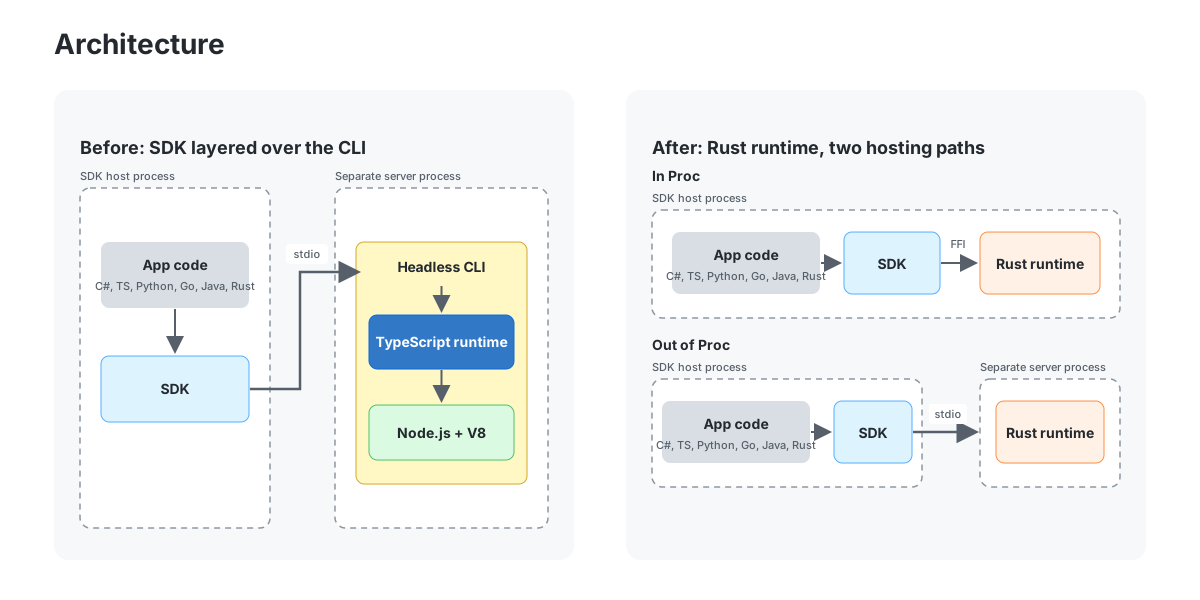
Porting a system of 800,000 lines of production code to Rust isn't just a technical exercise; it's a test of will against the inertia of legacy architecture. For years, the idea of rewriting the core of a major AI runtime seemed like a monumental, perhaps insurmountable, task. The sheer scale of the codebase, combined with the risk of introducing regressions in a live service, created a perfect storm of hesitation. We looked at the mountain of C++ and decided it was simply too expensive, too risky, and frankly, not affordable given the resources required to maintain two parallel codebases for years.
Then came the shift in how we approached the problem: we didn't just write Rust; we asked an AI to help us write it. By leveraging GitHub Copilot not merely as an autocomplete tool but as a strategic partner in the migration, we fundamentally altered the cost-benefit analysis of the rewrite. The agent didn't just suggest syntax; it understood the architectural patterns, the data flow, and the specific constraints of the Copilot runtime. It acted as a force multiplier, turning a daunting migration project that would have taken a team of senior engineers months into a process that felt manageable, even at a massive scale.
The journey wasn't without its moments of friction. There were days when the AI generated code that looked perfect on the surface but failed under the specific load conditions of our production environment. These moments required a delicate dance between human oversight and machine generation, where the engineer's role shifted from writing every line to curating and validating the output. We learned that the most valuable contribution of Copilot wasn't the volume of code produced, but its ability to rapidly prototype solutions for complex edge cases, allowing us to iterate on the Rust implementation with a speed and confidence that was previously impossible.
Beyond the technical translation, the migration offered a profound shift in developer experience. Rust's ownership model forced us to confront memory safety issues that had been papered over for years in the C++ version. It wasn't just about performance gains or lower latency; it was about building a foundation that simply couldn't leak or crash due to use-after-free errors. The rewrite became a lesson in discipline, proving that the right tool, even when it's an AI agent, can help a team adopt stricter engineering practices without stifling innovation.
Looking back, the success of this migration challenges the conventional wisdom that large-scale rewrites must be slow, costly, and fraught with peril. It demonstrates that when you combine the rigorous standards of a systems language like Rust with the generative speed of modern AI agents, you can tackle problems that were previously considered unaffordable. The 800,000 lines of new code stand today not just as a refactor, but as a testament to a new paradigm in software engineering—one where the boundaries of what a team can build are defined less by the number of hours they have, and more by the intelligence of the tools they wield.
On Bluesky? Meet HomeSky.
Follower analytics, a growth toolkit, scheduling and AI posting — built for Bluesky. Connect your account and use everything free for 60 days.
Try HomeSky free →