Migrating the GitHub Copilot runtime to Rust, using Copilot
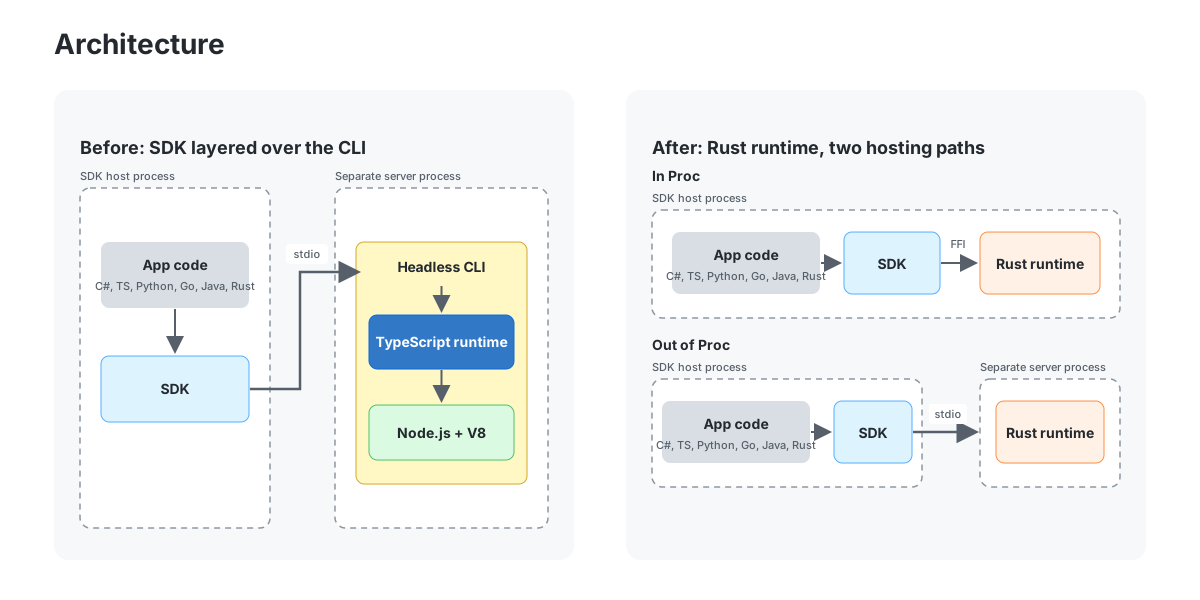
Before the era of autonomous agents, a migration of this magnitude was simply not in the cards. The idea of porting the GitHub Copilot runtime from Go to Rust, a language renowned for its safety guarantees and performance, seemed like a logistical nightmare that would consume resources far beyond any reasonable budget. The sheer scale of the undertaking, involving nearly 800,000 lines of production code, stood as a monumental barrier that traditional engineering teams believed could only be conquered with armies of developers and years of grueling manual refactoring.
The catalyst for this change was not a sudden burst of inspiration, but a quiet realization that the underlying infrastructure needed to evolve alongside the capabilities of the models it supports. As the agent ecosystem matured, the demands on the runtime grew exponentially, requiring a level of memory safety and concurrency that the previous architecture struggled to provide without significant overhead. The decision to rewrite the core was driven by a need for reliability; in a system where suggestions are generated in real-time for thousands of developers, any runtime instability translates directly to user frustration and broken workflows.
What made this particular rewrite unique was the weaponization of the very tool being built. Instead of writing a separate set of scripts to perform the migration, the team leveraged Copilot itself to orchestrate the porting process. This created a recursive loop of improvement where the agent would propose Rust implementations, the team would review them, and then use those same patterns to refine the agent's own capabilities. It was a meta-engineering exercise that blurred the line between the builder and the tool, allowing the system to learn by doing while simultaneously rebuilding itself.
The process was not a straight line to perfection; it was a chaotic dance of iteration, failure, and correction. Early attempts resulted in code that compiled but failed under load, revealing subtle bugs in the logic that human reviewers might have missed amidst the sheer volume of changes. Yet, the integration of AI assistance allowed the team to navigate these complexities with unprecedented speed, identifying patterns in the errors and adjusting the prompts to guide the agent toward more robust solutions. It was a testament to how quickly the paradigm of software development is shifting from static documentation to dynamic, collaborative generation.
Ultimately, the successful migration of the Copilot runtime to Rust marks a pivotal moment in the history of developer tools. It proves that the future of large-scale infrastructure is not just about writing better code, but about building systems that can help write better code. This achievement demonstrates that the boundaries of what is affordable in software engineering are expanding, driven by the symbiotic relationship between human intent and artificial intelligence. As we look forward, this experiment serves as a blueprint for the next generation of complex migrations, showing that even the most daunting technical challenges can be met with the right combination of vision and the right tool.
On Bluesky? Meet HomeSky.
Follower analytics, a growth toolkit, scheduling and AI posting — built for Bluesky. Connect your account and use everything free for 60 days.
Try HomeSky free →