Migrating the GitHub Copilot runtime to Rust, using Copilot
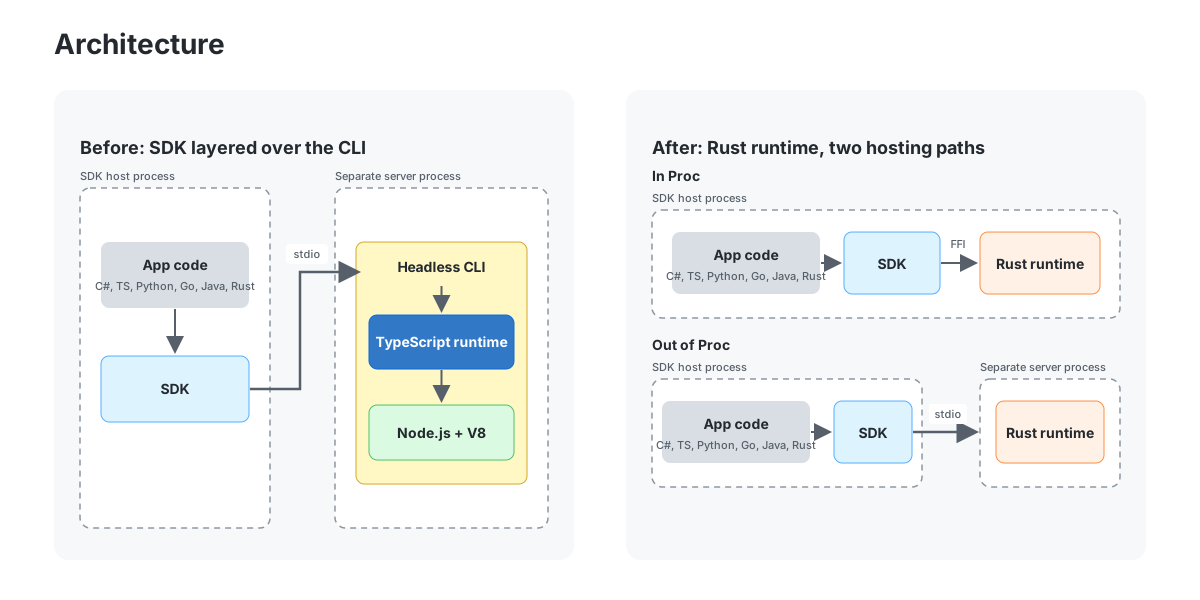
For years, the idea of rewriting a massive enterprise service in a new language was a theoretical exercise reserved for white papers, not a practical reality for production systems. The GitHub Copilot agent runtime, a critical piece of infrastructure supporting millions of developers, was no exception. It was a sprawling beast of C++ and other legacy languages, tightly coupled and difficult to untangle. We knew we needed the performance and memory safety of Rust, but the sheer scale of the migration—roughly 800,000 lines of production code—seemed to defy economic logic. The cost of manual translation, testing, and regression analysis would have been astronomical, effectively pricing the project out of existence before a single line of new code was written.
That changed when we turned the tool itself against the problem. Instead of treating the migration as a purely human endeavor, we leveraged the very agent technology built on top of that runtime to help migrate the runtime itself. It was a recursive loop of engineering, using Copilot to generate, refactor, and verify Rust code while simultaneously running the original C++ implementation to validate behavior. This wasn't just about speed; it was about feasibility. By integrating the agent directly into the development lifecycle, we transformed an impossible task into a manageable workflow, proving that the AI could act as a senior engineer capable of understanding complex context and maintaining rigorous standards.
The process was not without its friction. Early attempts resulted in code that compiled but failed to function correctly under real-world load, highlighting the gap between generated syntax and architectural intent. However, the iterative feedback loop allowed us to narrow that gap rapidly. We established a rigorous testing framework where the Rust version would be validated against the C++ baseline for functional equivalence. This ensured that every time the agent proposed a change, we had a mathematical guarantee that the behavior remained consistent, allowing us to push forward with confidence rather than fear.
As the rewrite progressed, the benefits became increasingly apparent. The Rust implementation offered superior concurrency models and reduced memory footprint, directly improving the latency and throughput of the Copilot service. Developers noticed the difference immediately; the system felt snappier, more responsive, and more reliable. More importantly, the migration revealed hidden inefficiencies in the original architecture that the agent helped refactor into a more modular and maintainable structure. The result was not just a code translation, but a genuine architectural upgrade that future-proofed the service against the evolving demands of the developer ecosystem.
Ultimately, this migration stands as a testament to the shifting paradigm of software engineering. It demonstrates that the barrier to large-scale infrastructure modernization is no longer solely technical expertise or budget, but rather the ability to orchestrate tools effectively. By using Copilot to migrate Copilot, we didn't just rewrite a runtime; we validated a new way of thinking about system evolution. The journey from a theoretical impossibility to a live, high-performance system in just a few months proves that the future of software development lies in the symbiotic relationship between human intent and machine execution.
On Bluesky? Meet HomeSky.
Follower analytics, a growth toolkit, scheduling and AI posting — built for Bluesky. Connect your account and use everything free for 60 days.
Try HomeSky free →