Migrating the GitHub Copilot runtime to Rust, using Copilot
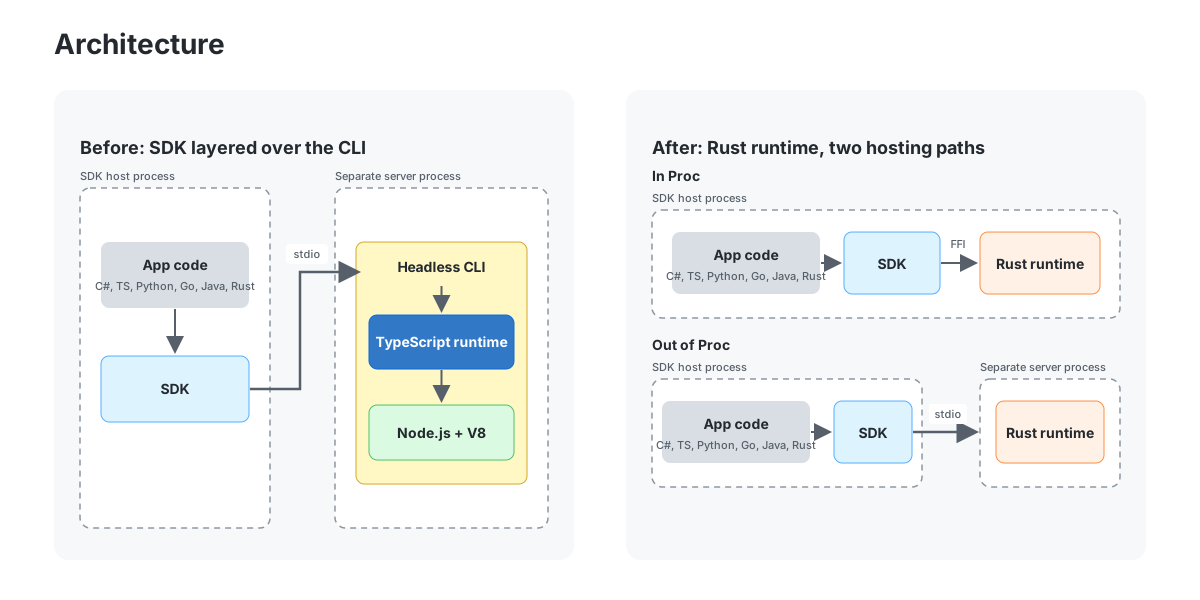
For years, the thought of rewriting the GitHub Copilot agent runtime in Rust felt like a fantasy reserved for the realm of science fiction, a task so monumental that it seemed economically impossible. The sheer volume of code involved—roughly 800,000 lines of production-grade logic—represented a mountain that traditional engineering teams had no realistic path to climb without breaking the bank. Before the emergence of AI agents capable of self-correction and autonomous refinement, this rewrite was not just difficult; it was unaffordable, a project that would likely have stalled under the weight of its own complexity before a single line of Rust was committed.
The pivot point came not from a sudden surge in funding, but from a fundamental shift in how we approach large-scale code migration. By leveraging Copilot itself to rewrite Copilot, we turned the impossible into a manageable workflow. This was not merely a case of using a tool to automate a tedious task; it was a recursive loop where the agent became the architect, the coder, and the reviewer simultaneously. The paradigm shift allowed us to bypass the years of manual refactoring that would have previously been required, essentially compressing a multi-year effort into a focused sprint that challenged our existing definitions of software delivery.
However, the transition was far from seamless. Porting such a massive system required navigating a minefield of edge cases, performance bottlenecks, and architectural dependencies that no amount of documentation could fully predict. The Rust compiler, with its strict memory safety guarantees and borrow checker, demanded a level of precision that the legacy codebase, written in a more flexible language, had never needed to enforce. We found ourselves constantly debugging not just the code Copilot generated, but the very logic of how the agent reasoned about the constraints of the new language, creating a unique feedback loop where human oversight became a critical component of the AI's learning curve.
As the migration progressed, the benefits began to materialize in ways that extended far beyond simple performance metrics. Rust's zero-cost abstractions allowed us to trim fat from the runtime, reducing latency and memory overhead while simultaneously hardening the system against entire classes of security vulnerabilities. The resulting codebase was leaner, faster, and more resilient, proving that the investment in such a radical rewrite yielded compounding returns in reliability and efficiency. It validated the hypothesis that modern AI tools could handle the heavy lifting of structural transformation, allowing human engineers to focus on high-level design rather than line-by-line translation.
This journey underscores a broader truth about the evolving landscape of software engineering: the tools we build today will inevitably be the tools that rebuild them tomorrow. The successful migration of the Copilot runtime to Rust stands as a testament to the power of combining human intent with machine scale. It demonstrates that when we align our engineering processes with the capabilities of the tools we create, we can achieve feats of productivity that were once thought to be out of reach, transforming what was once a prohibitive cost into a strategic advantage.
Ultimately, this rewrite was more than just a technical exercise; it was a validation of a new era in development where the barriers to entry for massive infrastructure projects are rapidly disappearing. By letting Copilot help us migrate to Rust, we didn't just update a codebase; we redefined the potential of what an engineering team can accomplish when empowered by the very intelligence they are building. The path forward is now clearer, faster, and infinitely more ambitious than it was a year ago.
On Bluesky? Meet HomeSky.
Follower analytics, a growth toolkit, scheduling and AI posting — built for Bluesky. Connect your account and use everything free for 60 days.
Try HomeSky free →