Migrating the GitHub Copilot runtime to Rust, using Copilot
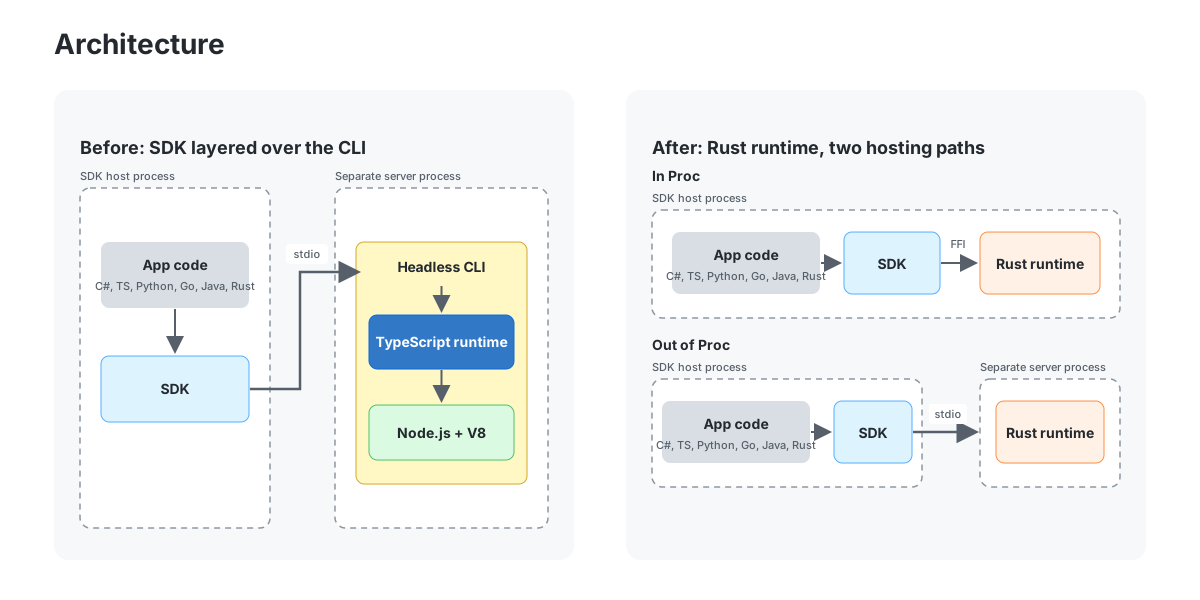
For years, the idea of rewriting a massive, production-grade codebase in Rust felt like a theoretical exercise in compiler theory rather than a practical engineering challenge. We often joked that porting the Copilot agent runtime was a task best left to the next generation of compilers or quantum processors, simply because the cost of downtime during such a migration outweighed the potential performance gains. The sheer volume of logic, embedded within roughly 800,000 lines of existing code, seemed to form an immovable wall of legacy debt that no single team could breach without catastrophic risk.
That calculation changed overnight when artificial intelligence agents stopped being a novelty and became a viable tool for large-scale refactoring. We found that the very technology we were building—Copilot—could be turned back on itself to execute the migration. Instead of human engineers manually translating syntax or architecting every single step of the port, we deployed an agent to act as both the architect and the worker bee, navigating the labyrinth of our own code to identify dependencies, manage state transitions, and write the new Rust logic in real-time.
The process was not without its friction, but the nature of that friction was different from what we were used to. It wasn't the slow grind of typing out thousands of lines of boilerplate or the endless debates over memory safety guarantees; it was the iterative dance of debugging the agent's own mistakes. We watched as the tool generated code that compiled but didn't behave, then watched it self-correct by analyzing the test failures and rewriting the logic until the green checkmarks appeared. It was a feedback loop that accelerated the work by orders of magnitude, turning a year-long project into a matter of months.
What makes this shift particularly significant is not just the speed, but the cultural validation it provides for the Rust ecosystem. Rust has long been viewed as the "safe" choice for performance-critical systems, but the barrier to entry for migrating existing C++ or Go projects has historically been prohibitive. By using Copilot to bridge that gap, we demonstrated that the ecosystem is now mature enough to handle the heavy lifting of enterprise-scale migration, making the language a practical option for maintaining massive systems rather than just a niche for greenfield startups.
Looking back at the journey, the most profound realization was that the line between the developer and the tool has blurred in a way that was unimaginable five years ago. We didn't just use Copilot to write snippets; we used it to rewrite the engine that drives our most advanced AI coding assistant. It serves as a testament to the power of modern development tools to amplify human intent, allowing us to tackle problems of such scale that they previously seemed insurmountable. The runtime is now running faster, safer, and more efficiently than ever before, all because we finally gave the right tools to do the heavy lifting.
On Bluesky? Meet HomeSky.
Follower analytics, a growth toolkit, scheduling and AI posting — built for Bluesky. Connect your account and use everything free for 60 days.
Try HomeSky free →