Migrating the GitHub Copilot runtime to Rust, using Copilot
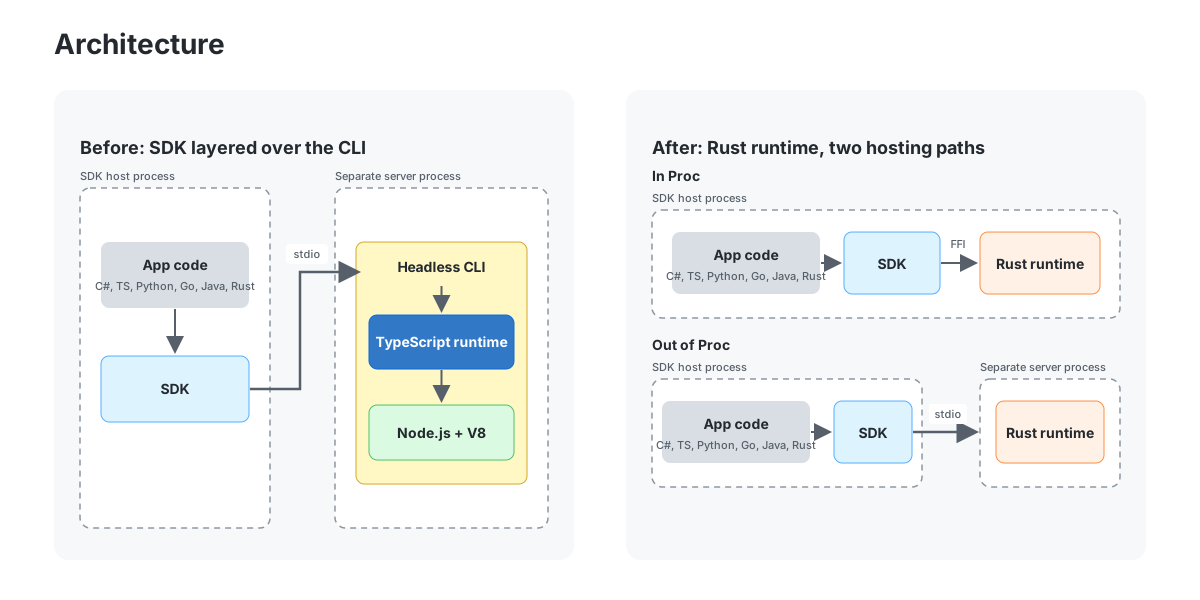
Before artificial intelligence agents could automate the tedium of refactoring, the idea of rewriting a massive codebase was a logistical nightmare. Moving the GitHub Copilot runtime from its previous implementation to Rust, a language known for its performance and memory safety, involved porting approximately 800,000 lines of production code. In the era before LLMs could understand context and generate functional replacements, this would have required armies of engineers, years of planning, and a significant risk of introducing subtle, hard-to-debug bugs.
The decision to attempt this migration was driven by a fundamental need for reliability and speed. The original runtime, written in a dynamically typed language, offered rapid development but suffered from performance bottlenecks and occasional type safety issues that threatened the stability of the service. Rust, with its strict compile-time guarantees, promised a more robust foundation. The challenge wasn't just about translating syntax; it was about ensuring that the complex logic governing the agent's interactions, memory management, and concurrency models remained intact while gaining the rigorous safety guarantees that Rust provides.
The process of writing the new code was surprisingly meta, as we leveraged Copilot itself to facilitate the rewrite. By prompting the AI with the intent to migrate specific modules to Rust, we were able to generate a vast amount of boilerplate code and initial logic. This wasn't a black-box magic trick; it was a collaborative loop where the human architect reviewed, corrected, and refined the AI's suggestions. The AI acted as a force multiplier, handling the repetitive, syntax-heavy tasks while humans focused on the architectural decisions and the edge cases that machines often miss.
However, relying on an AI to rewrite a critical production system introduced its own unique set of risks. The AI could confidently generate code that looked correct but failed under specific load conditions or had incorrect assumptions about the existing data structures. We had to build a rigorous testing framework and a phased rollout strategy to validate every piece of migrated code. This involved creating thousands of unit tests and integration scenarios to ensure that the new Rust implementation behaved identically to the legacy system, effectively treating the AI's output as a first draft rather than a final product.
The result is a system that is faster, safer, and easier to maintain than its predecessor. The Rust runtime handles concurrency with a level of predictability that was difficult to achieve in the previous environment, reducing the latency for users waiting on Copilot suggestions. More importantly, the strict type system has eliminated entire classes of runtime errors, making the codebase significantly more resilient to changes. The migration proved that with the right tools and a disciplined approach, even the largest refactoring projects can be accelerated without sacrificing quality.
This project marks a turning point in how engineering teams approach legacy modernization. It demonstrates that AI agents are not just assistants for writing new code, but capable partners in the monumental task of rebuilding existing systems. The journey from concept to a stable, 800,000-line Rust runtime shows that the future of software development lies in a symbiotic relationship between human expertise and artificial intelligence, where the former guides the architecture and the latter accelerates the execution.
On Bluesky? Meet HomeSky.
Follower analytics, a growth toolkit, scheduling and AI posting — built for Bluesky. Connect your account and use everything free for 60 days.
Try HomeSky free →