Migrating the GitHub Copilot runtime to Rust, using Copilot
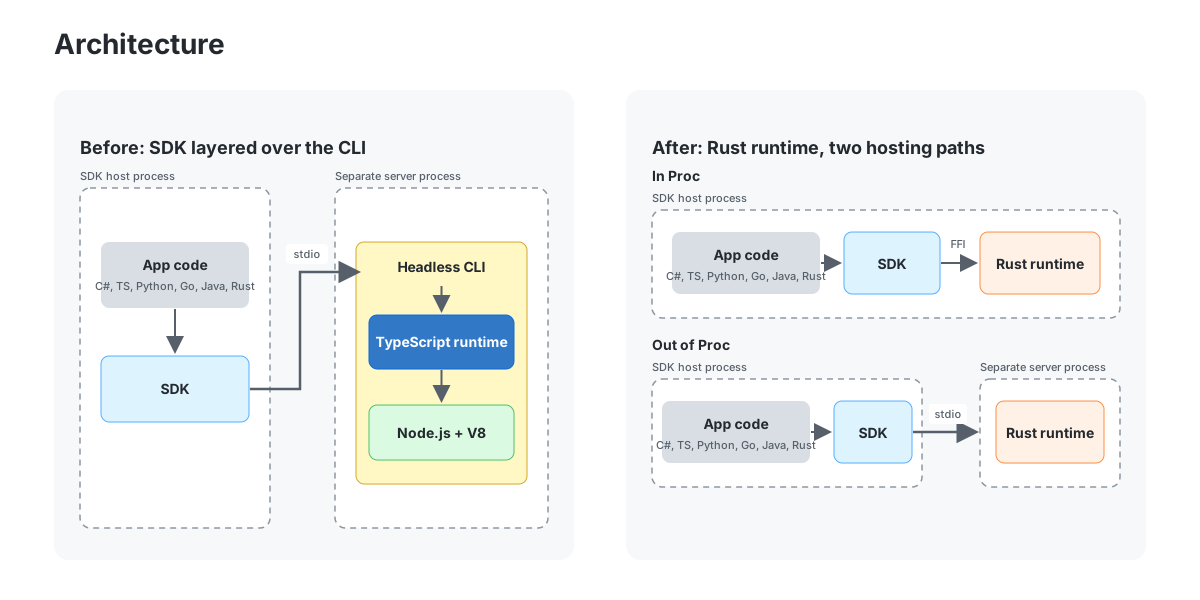
Before the era of autonomous agents could even dream of rewriting their own legacy, the idea of porting a critical system to a new language was a monumental, often insurmountable task. The GitHub Copilot runtime, a complex engine powering thousands of lines of code generation, sat firmly in the realm of established tools that simply had to endure their current architecture. Moving such a beast to Rust wasn't just a refactor; it was a complete architectural resurrection, yet we found ourselves facing a paradox: the very agents we built were the only things capable of executing the migration we needed.
The scale of this undertaking was staggering, involving roughly 800,000 lines of production Rust code. In a traditional development cycle, this would have been the domain of large teams working for years, fraught with the risk of regression and the slow grind of manual verification. Instead, we leveraged the Copilot agent itself to act as the architect and the builder simultaneously. This wasn't about asking an AI to write a simple script; it was about delegating the cognitive load of a massive systems engineering project to the very infrastructure we were trying to upgrade, creating a self-reinforcing loop of improvement.
The technical hurdles were not merely about syntax translation but about preserving the soul of the system. Every data structure, every concurrency model, and every error handling mechanism had to be scrutinized and rebuilt to fit Rust's strict ownership model. The agent didn't just generate code; it engaged in a continuous dialogue of intent, constantly verifying that the generated logic aligned with the original behavior. It was a process of negotiation between human-defined constraints and machine-generated solutions, ensuring that the new runtime was not just functionally equivalent but actually superior in performance and safety.
What emerged from this process was a profound shift in how we approach legacy modernization. The result was a runtime that is leaner, faster, and significantly more secure, proving that the boundaries between tooling and task execution are becoming increasingly porous. By allowing the Copilot agent to drive its own migration, we bypassed the bottleneck of human cognitive bandwidth, turning a theoretical impossibility into a concrete reality. This success story suggests that the future of software evolution lies not in more people, but in smarter, more integrated agents that can handle the heavy lifting of our most critical infrastructure.
Ultimately, this migration was more than a technical exercise; it was a validation of the agent paradigm. It demonstrated that when given the right context and the ability to reason about its own codebase, an AI can navigate the treacherous waters of large-scale system rewriting with a precision that once seemed reserved for the most seasoned engineering teams. The 800,000 lines of Rust code now running the Copilot runtime stand as a testament to what is possible when we stop fighting the tools we build and start collaborating with them.
On Bluesky? Meet HomeSky.
Follower analytics, a growth toolkit, scheduling and AI posting — built for Bluesky. Connect your account and use everything free for 60 days.
Try HomeSky free →