Migrating the GitHub Copilot runtime to Rust, using Copilot
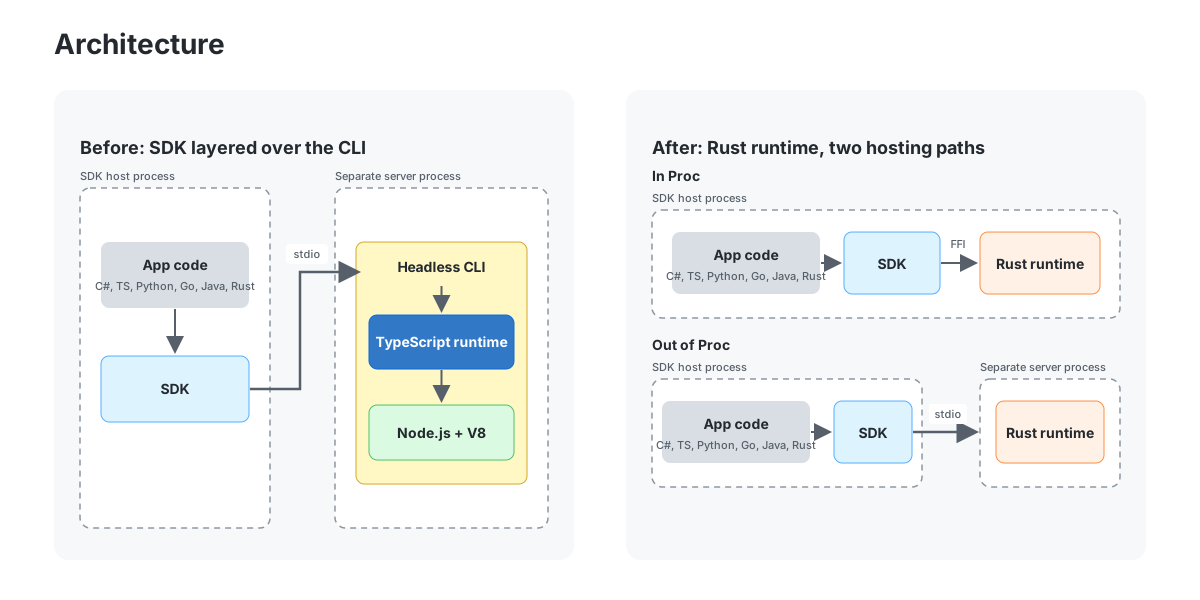
Before the era of AI agents, rewriting a complex system of 800,000 lines of code was an economic impossibility for most teams. The sheer volume of context required to understand the existing architecture, the subtle dependencies between modules, and the intricate logic of a distributed runtime meant that migration projects were often stalled by the prohibitive cost of human effort. We were stuck in a valley where the only way to move forward was to hire armies of developers, hoping that the sum of their individual understandings would eventually reconstruct the whole without losing the soul of the original design.
Then came the Copilot agent, a tool that fundamentally shifted the paradigm of software engineering. It wasn't just an autocomplete suggestion box; it was a cognitive partner capable of ingesting massive codebases, understanding intent, and executing complex refactoring tasks with a level of nuance previously reserved for senior architects. This shift transformed the equation of migration, turning a project that would have taken years and millions of dollars into a sprint that could be completed by a smaller, more focused team armed with the right intelligence.
The journey of porting the GitHub Copilot runtime to Rust was not a straightforward translation of syntax; it was a deep dive into the philosophy of ownership and memory safety that defines the language. The original runtime was built in Go, a language chosen for its concurrency model and ease of deployment. However, the goal was to leverage Rust's unparalleled safety guarantees and performance characteristics to create a more robust foundation for the future of AI-assisted development. Every module, from the core orchestrator to the plugin interfaces, had to be meticulously rebuilt, ensuring that the new implementation not only matched the old behavior but surpassed it in reliability and efficiency.
What surprised us most was the depth of the agent's understanding during the rewrite. It didn't just look at function signatures; it grasped the architectural patterns, the historical debt accumulated over years, and the specific constraints of the production environment. When the agent encountered a tricky race condition or a complex state management issue, it didn't offer generic solutions. Instead, it proposed architectural changes that respected the domain logic, often suggesting optimizations that human engineers had overlooked for years. It felt less like using a tool and more like collaborating with a brilliant colleague who had been reading your mind.
The result is a system that runs significantly faster and is far more secure than its predecessor. By moving to Rust, we eliminated the possibility of data races and null pointer exceptions, two of the most common sources of bugs in long-running services. The 800,000 lines of new code represent a complete reimagining of the runtime, but thanks to the agent, the process felt less like a reconstruction and more like a natural evolution. We achieved a level of code quality and maintainability that would have been the dream of any engineering lead a few years ago.
This migration proves that the future of large-scale software development is not about hiring more people, but about empowering the people we have with better tools. The barrier to entry for tackling massive legacy systems has been lowered, allowing teams to focus on innovation rather than maintenance. As we look to the future, the integration of AI agents into the core of our development workflows will likely become as standard as version control or containerization today, reshaping how we build, refactor, and evolve the digital infrastructure that powers our world.
On Bluesky? Meet HomeSky.
Follower analytics, a growth toolkit, scheduling and AI posting — built for Bluesky. Connect your account and use everything free for 60 days.
Try HomeSky free →