Migrating the GitHub Copilot runtime to Rust, using Copilot
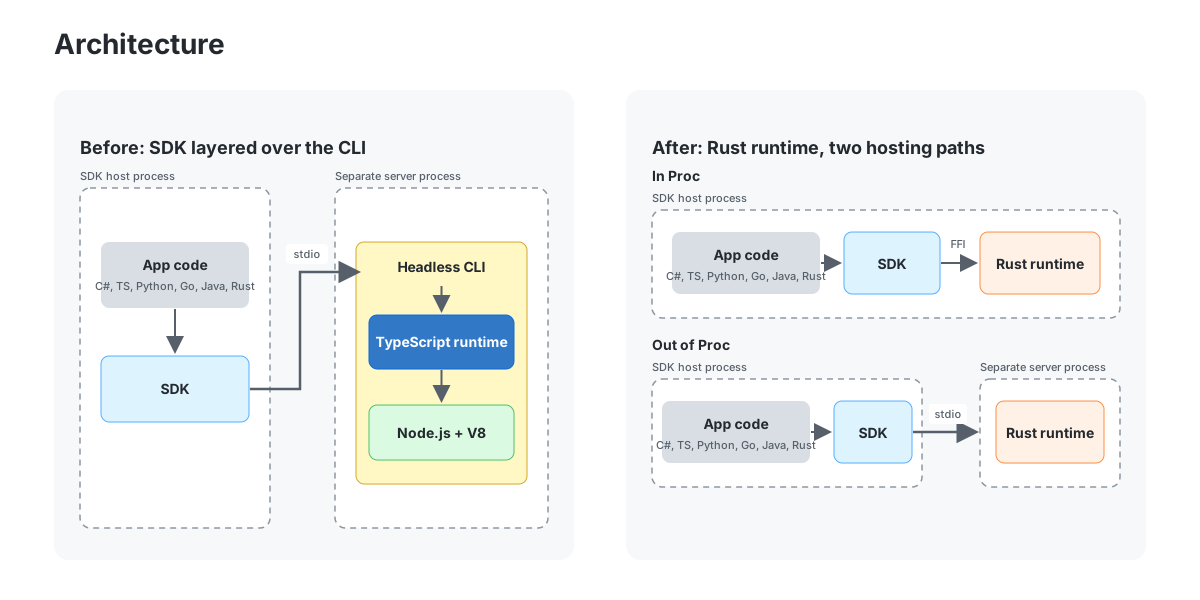
Before the era of autonomous agents, a rewrite of this magnitude was simply not economically viable. The sheer volume of code required to port a complex runtime to a new language represented a cost that no team could justify without a guaranteed, immediate payoff. We were looking at eight hundred thousand lines of production Rust, a task that would have traditionally required years of dedicated engineering time and a budget that would have strained any organization. The premise was that we could not afford to re-implement the entire Copilot agent runtime in Rust if we were to do it manually, relying solely on human developers to translate logic from one paradigm to another.
The shift in strategy came from a fundamental realization about how code is actually written and understood today. By leveraging Copilot itself to assist in the migration, we turned the tool into a primary workforce rather than just an editor's companion. This approach allowed us to treat the migration not as a manual translation exercise, but as a collaborative engineering effort where the AI handled the repetitive scaffolding and the team focused on architectural integrity. It was a meta-problem: using an agent to build the infrastructure that supports the agent, creating a self-reinforcing loop of efficiency and scale that was previously impossible to conceive.
What emerged from this process was a rigorous test of both human oversight and machine capability. The challenge wasn't just about syntax translation; it was about ensuring that the semantic meaning of the original logic survived the transition intact. Every time Copilot suggested a Rust implementation for a complex Python or JavaScript construct, engineers had to verify that the underlying intent remained true to the original specification. This required a deep understanding of the runtime's inner workings, ensuring that the resulting codebase was not only functional but also maintainable and performant.
The result is a production-grade Rust runtime that powers the Copilot experience for millions of developers. This achievement highlights a broader trend in software development where the line between tool and teammate is blurring. By accepting the assistance of AI in such a massive undertaking, we demonstrated that large-scale architectural changes can be accelerated without sacrificing quality. It proved that the bottleneck in modern software engineering is often not the lack of ideas or the complexity of the problem, but the sheer volume of tedious work that stands in the way of innovation.
Looking back, the migration stands as a testament to the potential of integrating AI deeply into the core workflows of high-stakes projects. It was not a case of replacing human judgment with automation, but rather of amplifying human intellect with computational assistance. The journey from an unaffordable proposition to a reality that powers the future of coding underscores a critical truth: the tools we build today will inevitably shape the way we build tomorrow.
On Bluesky? Meet HomeSky.
Follower analytics, a growth toolkit, scheduling and AI posting — built for Bluesky. Connect your account and use everything free for 60 days.
Try HomeSky free →