Migrating the GitHub Copilot runtime to Rust, using Copilot
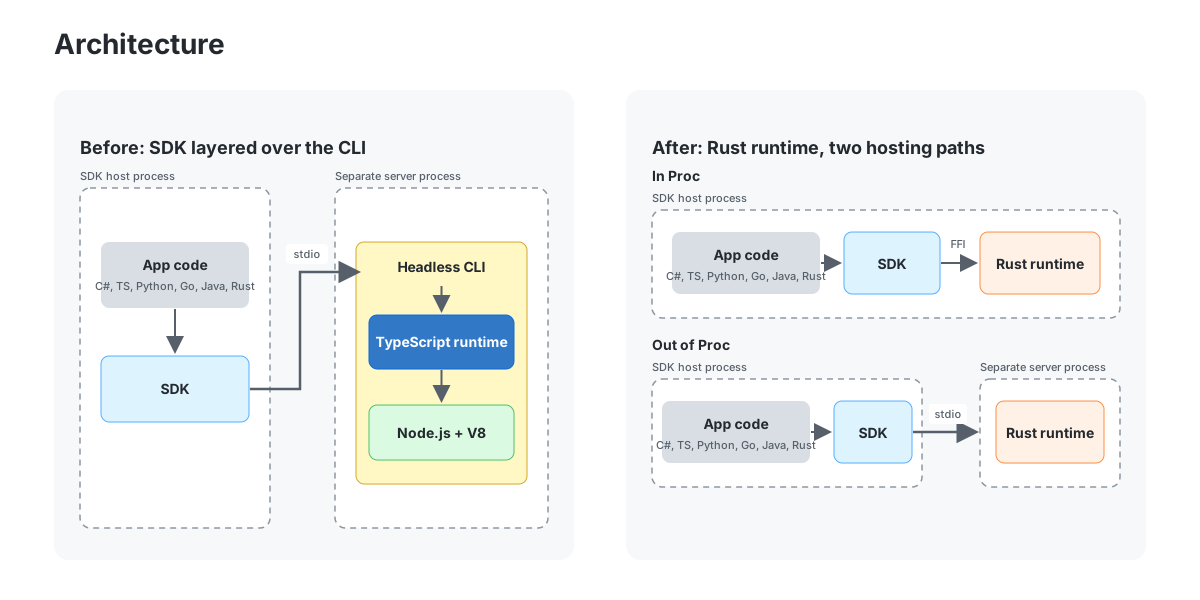
Before the era of autonomous agents, a codebase of this magnitude was a project that simply would not have been afforded the time or resources necessary for a complete rewrite. We were operating under the rigid constraints of legacy architecture, where the cost of refactoring exceeded the perceived value of the destination, leaving millions of lines of Go code as a permanent fixture in our infrastructure. That mindset had to change when we realized that the very tool we built to assist developers—GitHub Copilot—could be used to assist us in rebuilding its own engine.
Porting the Copilot agent runtime to 800,000 lines of production-quality Rust was not a theoretical exercise; it was a high-stakes migration undertaken in live production. The decision to adopt Rust was driven by a singular, non-negotiable goal: to eliminate the memory safety vulnerabilities that had plagued our previous implementation for years. We were not looking for a cosmetic upgrade; we needed a fortress. The transition required us to trust an AI to write code that had to meet enterprise-grade reliability standards, a level of confidence that usually requires a team of senior engineers reviewing every line manually.
The process itself became a meta-commentary on the evolution of software development. We fed the AI our existing Go codebase, asking it to translate, optimize, and refactor while simultaneously adhering to strict Rust idioms and safety guarantees. It was a chaotic dance of correction and validation, where the AI would generate a brilliant solution that only to break a subtle concurrency invariant, requiring human intervention to fix the logic before the next iteration could proceed. It was not magic; it was a relentless cycle of generation, analysis, and refinement that pushed the boundaries of what an LLM could achieve in a real-world context.
The result is a runtime that is significantly faster, more memory-efficient, and critically, safe. By moving to Rust, we reduced the attack surface of the entire system, ensuring that the intelligence powering our most popular product could not be compromised by the very infrastructure it runs on. This migration proves that the gap between AI-assisted coding and autonomous engineering is closing rapidly. What once took a team of ten developers a year is now being accomplished in a fraction of the time, with a level of consistency that human-only teams struggle to maintain over such a vast codebase.
Ultimately, this rewrite is more than just a technical achievement; it is a validation of a new paradigm in how we build large-scale systems. We learned that the best way to ensure the future of our tools is to let those tools help us build the future. The journey from Go to Rust was difficult, fraught with edge cases and unforeseen complexities, but it stands as a testament to the power of leveraging our own innovations to solve the problems that created them. We didn't just migrate a codebase; we migrated our approach to engineering itself.
On Bluesky? Meet HomeSky.
Follower analytics, a growth toolkit, scheduling and AI posting — built for Bluesky. Connect your account and use everything free for 60 days.
Try HomeSky free →