Migrating the GitHub Copilot runtime to Rust, using Copilot
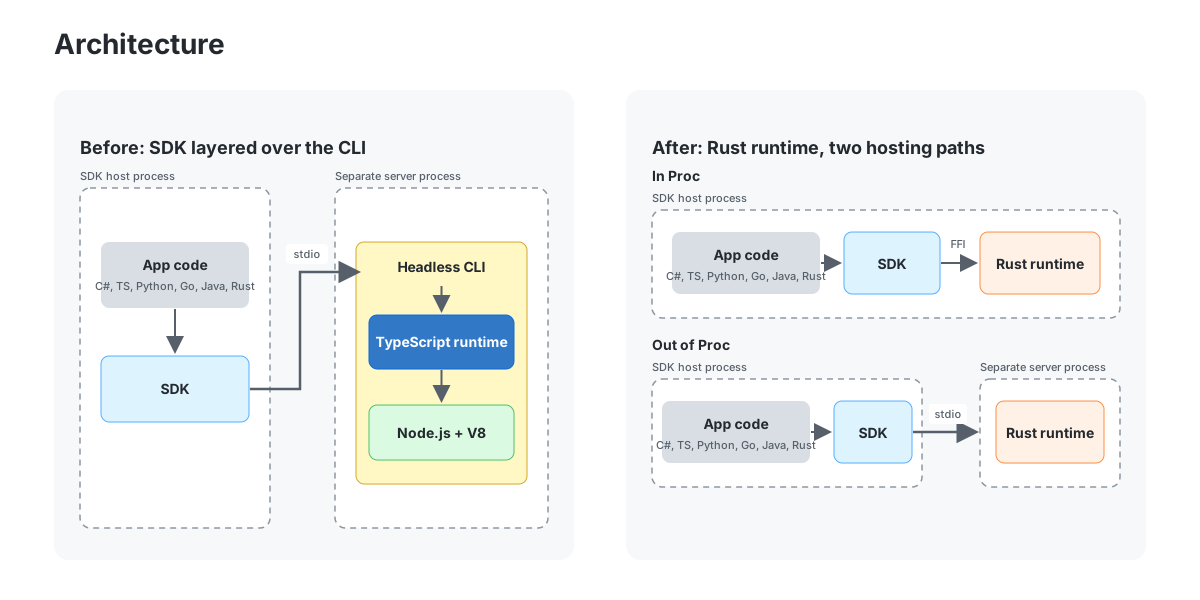
For years, the prospect of rewriting the GitHub Copilot runtime in Rust felt like a logistical impossibility. The sheer volume of code, sitting somewhere around 800,000 lines, represented a mountain that seemed to require an army of engineers and months of uninterrupted toil. We were operating under the old calculus of software development, where moving a complex system from a legacy language to a modern one was a high-risk, high-cost operation. We assumed that the only way to do this safely was to freeze the feature, strip away the production load, and build a pristine new version in a vacuum, a process that would inevitably delay users and risk breaking things in the transition.
But the landscape of software engineering has shifted beneath our feet, and the arrival of AI agents changed the cost-benefit analysis entirely. What once required a team of five for six months could now be tackled by a single developer with the right tools. The irony was palpable: we were using GitHub Copilot, the very product we were building, to build itself. It was a recursive loop of creation that defied the traditional constraints of human bandwidth. The question wasn't just whether we could write the code, but whether the AI could understand the nuance of a system that had been refined over years of production usage and subtle edge cases.
The process began with the audacious decision to let the agents drive the migration rather than humans meticulously translating line by line. We set the stage by configuring the environment to understand the existing architecture, the specific libraries involved, and the behavioral contracts that the Rust version needed to uphold. The AI didn't just generate syntax; it reasoned about state management, concurrency models, and memory safety guarantees that Rust enforces by design. It was a dance where the human provided the strategic direction and the safety rails, while the machine handled the relentless, repetitive grinding of converting idioms from one language to another.
As the rewrite progressed, the narrative took a surprising turn. The AI agents were not perfect, and they did make mistakes, but the error rate was manageable and the recovery time was instantaneous. When a generated snippet failed a test or introduced a type error, the agent immediately analyzed the failure, consulted the existing documentation, and proposed a correction. This feedback loop was far faster than a human developer could achieve alone. We watched as the system iterated on its own solutions, refining the logic of the new runtime until it matched the reliability of the legacy version. It felt less like a migration and more like a collaborative evolution.
The result is a runtime that is not only faster and more memory-efficient but also significantly more maintainable. Rust's ownership model has eliminated entire classes of runtime bugs that plagued the original implementation, and the codebase is now a joy to navigate compared to the spaghetti of the past. The 800,000 lines of code now serve as a testament to what is possible when human intent is amplified by artificial intelligence. We have proven that the tools we build today can be the architects of their own future, breaking the ceiling on what a single developer can achieve in a professional setting.
Ultimately, this migration was more than a technical exercise; it was a validation of a new paradigm. We no longer need to choose between speed and safety, or between legacy stability and modern innovation. With the right agents, we can have both. The rewrite of the Copilot runtime stands as a beacon for the industry, showing that the future of software development isn't about doing more work; it's about leveraging intelligence to do less work while achieving much more. The mountain has been moved, not by brute force, but by the synergy of human vision and machine execution.
On Bluesky? Meet HomeSky.
Follower analytics, a growth toolkit, scheduling and AI posting — built for Bluesky. Connect your account and use everything free for 60 days.
Try HomeSky free →