Migrating the GitHub Copilot runtime to Rust, using Copilot
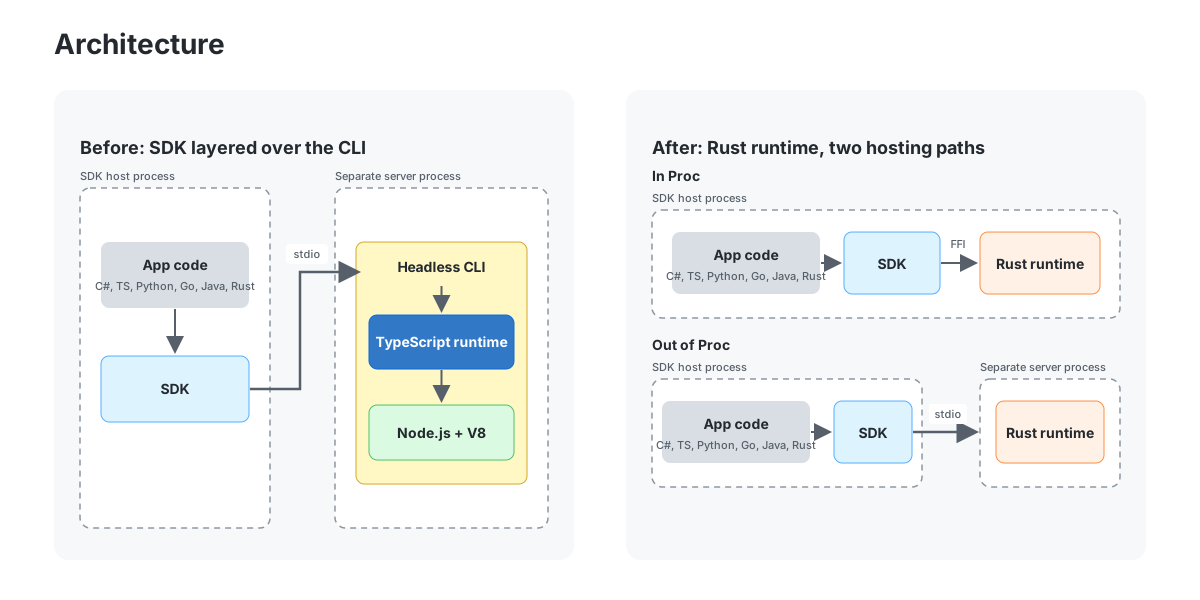
For years, the idea of rewriting a complex software ecosystem in Rust felt like a theoretical exercise reserved for academic papers or proof-of-concept prototypes. The sheer volume of code required to support a tool as ubiquitous as GitHub Copilot made the endeavor seem financially and logistically impossible. Before the advent of AI agents capable of understanding context and generating coherent code blocks, the cost of translation was prohibitive. You simply couldn't afford the man-hours required to manually refactor eight hundred thousand lines of production code, let alone the risk of introducing subtle regressions during the process.
That changed when we decided to stop treating Rust as a new language to learn and started treating it as a new way to think about our runtime architecture. We didn't just hand a compiler to a room full of tired engineers and hope for the best; we handed the task to an agent built on the very system we were trying to improve. It was a recursive loop of self-improvement where Copilot, the product, became the architect of its own infrastructure. The result was a migration that felt less like a traditional port and more like a guided evolution, where the agent anticipated edge cases and suggested optimizations that human reviewers might have missed in the heat of the moment.
The journey wasn't without its friction points. Porting a runtime involves managing state, handling concurrency, and ensuring that the feedback loop between the user and the AI remains instant and reliable. Rust's strict ownership model offered a safety net that our previous stack lacked, eliminating entire classes of memory bugs that had haunted us for years. However, the compiler's borrow checker could be a stubborn gatekeeper at times. Here, the agent stepped in as the mediator, proposing complex refactorings that satisfied the compiler's demands while preserving the original logic. It was a dance between human intuition and machine precision, where the agent would propose a solution, we would validate it against our internal logic, and then it would refine the approach based on our feedback.
What makes this migration truly significant is not just the technical victory, but the shift in how we approach large-scale system engineering. We are moving away from the bottleneck of human velocity toward a model where human judgment is amplified by intelligent automation. The agent didn't just write code; it understood the architectural intent behind the lines. It knew that a particular function was a critical path component and treated it with the care it deserved. This level of contextual awareness is what transforms code generation from a mere convenience into a strategic asset for maintaining massive codebases.
The outcome is a runtime that is faster, safer, and more resilient than ever before, all achieved without the usual exorbitant cost of a full-scale rewrite. We have proven that the future of software development isn't about choosing between human developers and AI tools; it's about integrating them into a symbiotic workflow where each enhances the other's capabilities. This migration stands as a testament to the potential of agents to tackle problems that were previously deemed unsolvable due to resource constraints.
Looking ahead, this work is just the beginning of a larger transformation in how we build and maintain software at scale. As our runtime continues to evolve, we will likely see even more opportunities to leverage AI not just for writing new features, but for refactoring legacy systems and optimizing performance in real-time. The bar for what is possible in software engineering has been raised, and the path forward is clearer than it was a year ago.
On Bluesky? Meet HomeSky.
Follower analytics, a growth toolkit, scheduling and AI posting — built for Bluesky. Connect your account and use everything free for 60 days.
Try HomeSky free →