Migrating the GitHub Copilot runtime to Rust, using Copilot
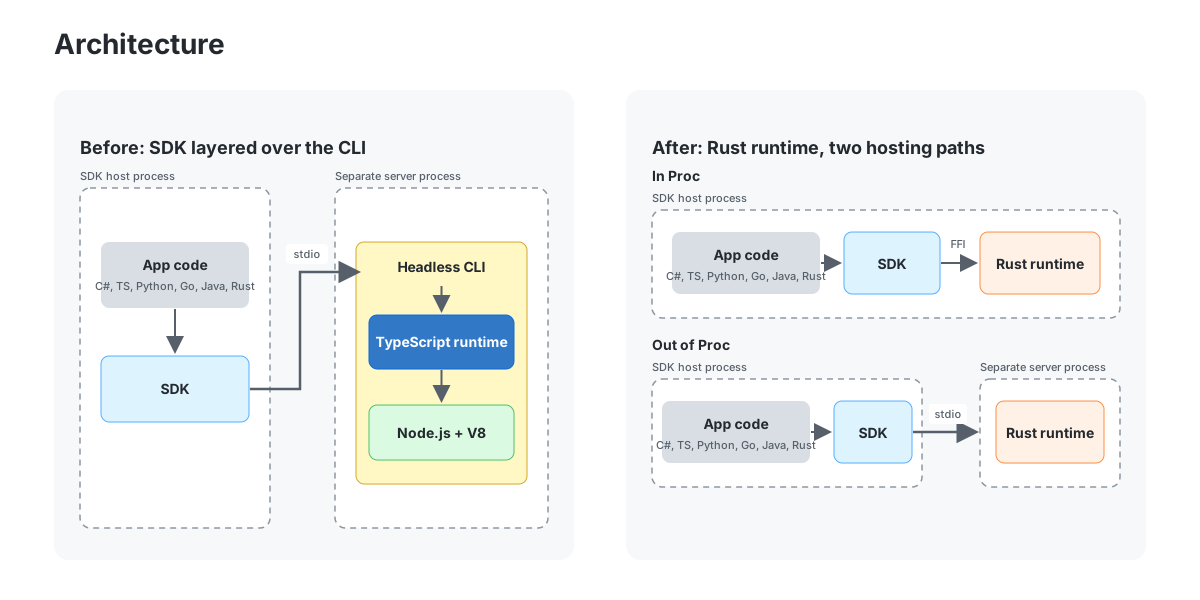
For years, the idea of rewriting a complex, production-grade system in Rust was a theoretical exercise reserved for academic papers or hobbyist side projects. The sheer scale of the task, involving nearly a million lines of code, felt like an insurmountable mountain, a job that would require armies of engineers and decades of toil. But the landscape of software development has shifted beneath our feet, driven by the rise of AI agents that can not just assist but actually execute the heavy lifting of code transformation. What once required a multi-year roadmap is now achievable in a matter of months, proving that the gap between "theoretically possible" and "practically feasible" has been bridged by tools that understand context as well as any human developer.
The migration of the GitHub Copilot runtime to Rust was never just a language switch; it was a fundamental re-architecture of how we think about reliability and performance in AI infrastructure. The original implementation, built on Python, was functional but constrained by the interpretive overhead and memory management limitations inherent to the language. As the Copilot agent grew more sophisticated, handling increasingly complex coding tasks for millions of developers, the need for a more robust foundation became critical. Rust offered the determinism and safety guarantees necessary to ensure that the AI-driven suggestions didn't just work well in theory but operated flawlessly under the immense load of real-world usage.
Porting 800,000 lines of code is a daunting prospect, but the true challenge lies in the invisible layers of the system: the intricate data flows, the edge cases buried in legacy logic, and the subtle interactions between components that only surface under stress. In previous eras, this would have been a gamble, a high-risk endeavor where a single misunderstanding of the original logic could have broken the system for everyone. Today, the integration of AI agents into the development workflow allows engineers to treat the migration as a collaborative exploration. The agents don't just write the new code; they read the old code, understand the intent, and generate test cases to verify that the behavior remains identical, creating a feedback loop that ensures fidelity throughout the transition.
This shift represents a broader paradigm change in how we approach large-scale engineering challenges. We are moving away from the era of manual, line-by-line refactoring toward an era of guided transformation where human expertise directs the strategy while AI handles the execution. It validates the notion that AI agents are not merely productivity tools for writing boilerplate but are now essential partners in system evolution. By leveraging these agents to handle the migration, the team was able to focus on architectural decisions and optimization rather than the tedious grind of syntax conversion, effectively turning a potential years-long project into a manageable sprint.
The result is a runtime that is not only faster and more secure but also demonstrates the maturity of the Rust ecosystem in supporting AI workloads. The successful migration serves as a powerful case study for the industry, showing that even the most entrenched systems can be modernized without losing the institutional knowledge embedded within their codebases. It proves that with the right tools, the fear of technical debt and the daunting scale of legacy systems can be overcome, paving the way for a future where software evolution is as swift and fluid as the code itself.
On Bluesky? Meet HomeSky.
Follower analytics, a growth toolkit, scheduling and AI posting — built for Bluesky. Connect your account and use everything free for 60 days.
Try HomeSky free →