Migrating the GitHub Copilot runtime to Rust, using Copilot
There was a time when rewriting a massive codebase felt like trying to move a mountain with a spoon, a task so prohibitively expensive that engineers would often stick with legacy C++ even when Rust offered a superior future. Before the advent of AI agents, the sheer volume of documentation, context switching, and manual verification required to port a system like the GitHub Copilot runtime made the cost of failure simply too high to justify the risk. We were stuck in a loop of hesitation, paralyzed by the fear that we would break something vital in the transition.
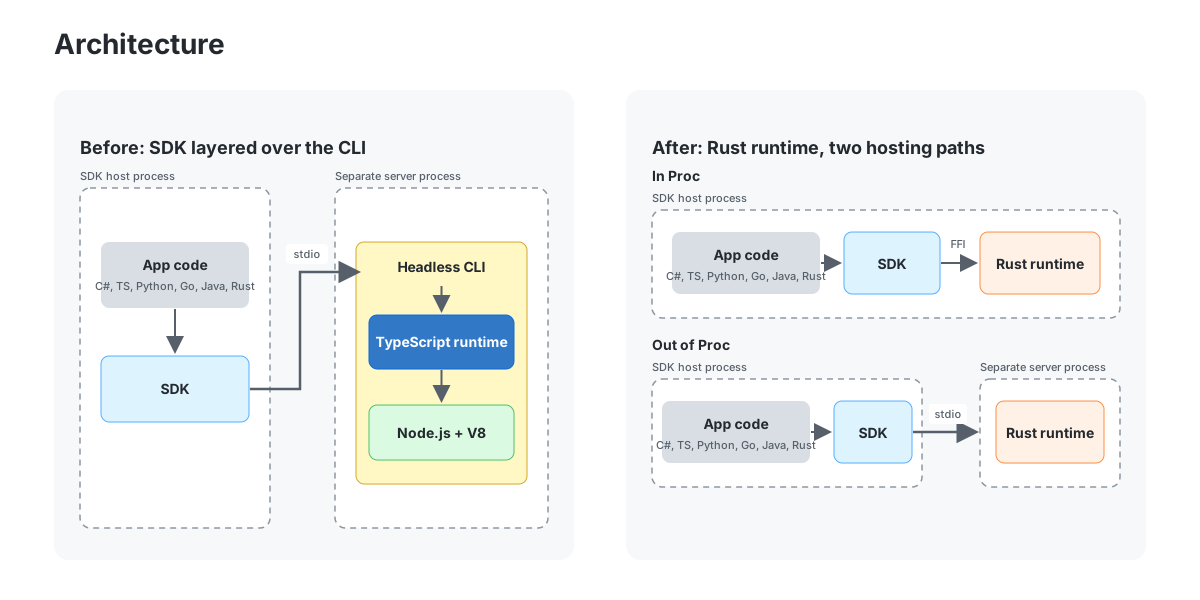
That hesitation evaporated the moment we decided to use Copilot itself to rewrite Copilot. The irony was palpable, yet the opportunity was irresistible: leveraging the very AI we had built to build the foundation upon which it ran. By shifting the entire runtime to nearly 800,000 lines of production Rust, we turned a theoretical architectural upgrade into a tangible reality, proving that modern AI agents could handle the heavy lifting of enterprise-grade porting in a way that was previously impossible.
The scale of this undertaking is difficult to overstate. We weren't just translating syntax; we were dismantling decades of accumulated complexity, rethinking memory safety guarantees, and ensuring that the new Rust implementation performed better than the original while maintaining every single line of business logic. It required a level of precision that only an AI, capable of reading and synthesizing the entire codebase simultaneously, could achieve. The AI didn't just suggest lines of code; it understood the architectural intent, the error handling patterns, and the subtle interactions between modules that a human might miss in a sea of 800,000 lines.
The results speak for themselves. The new Rust runtime isn't just a safer version of the old one; it is a leaner, faster, and more robust system that handles concurrency with a grace that C++ simply could not match without significant overhead. Memory safety is no longer an afterthought but a fundamental property of the system, eliminating an entire class of bugs that have plagued complex software for decades. We achieved a level of stability and performance that would have taken a team of senior engineers months, if not years, to verify manually.
This shift represents more than just a technical victory; it signals a fundamental change in how we approach large-scale engineering challenges. The era where AI agents are merely assistants for drafting emails is over; we are now in an era where they are essential co-pilots for architecting and migrating critical infrastructure. By embracing this tool, we unlocked a velocity of development that allows us to focus on solving new problems rather than wrestling with the constraints of old languages.
Looking ahead, the implications for the software industry are profound. If we can successfully migrate a monolithic, safety-critical agent runtime to Rust with the help of AI, the same pattern can be applied to countless other legacy systems facing modernization challenges. The barrier to entry for rewriting massive, complex systems has collapsed, opening the door to innovations that were previously blocked by the sheer cost and risk of transition. We are not just moving code; we are redefining the pace at which software can evolve.
On Bluesky? Meet HomeSky.
Follower analytics, a growth toolkit, scheduling and AI posting — built for Bluesky. Connect your account and use everything free for 60 days.
Try HomeSky free →