Migrating the GitHub Copilot runtime to Rust, using Copilot
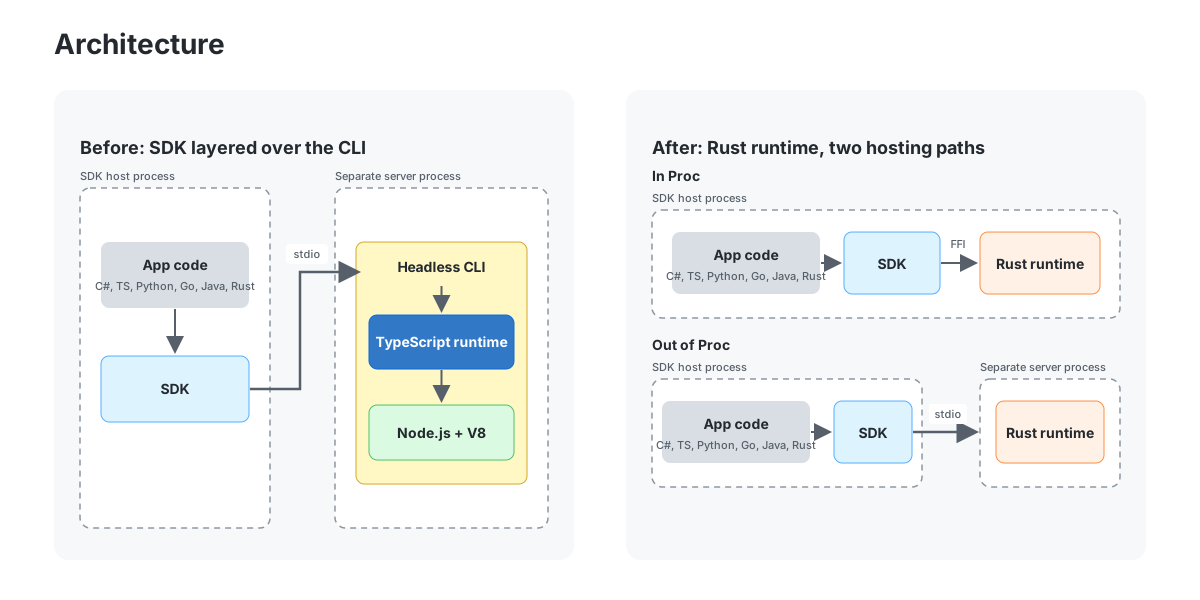
There was a time when rewriting a system of this magnitude felt like attempting to move a mountain with a spoon. Before the advent of AI agents, migrating a complex, high-throughput runtime required armies of engineers, months of planning, and a level of risk that often made leadership hesitate to even consider the move. The GitHub Copilot runtime, sitting at over 800,000 lines of production code, was a prime example of a legacy system where every line had been battle-tested but also weighed down by technical debt. The sheer volume of logic, the intricate interactions between language models and codebases, and the necessity for microsecond-level latency made the prospect of a rewrite seem economically unviable.
Then came the shift in capability that changed the equation entirely. We found that agents could do the heavy lifting, turning a task that previously required a decade of development into a sprint. The core question became not whether we could rewrite it, but whether we should. The answer, surprisingly, was a resounding yes. Rust offered a compelling value proposition: memory safety without garbage collection overhead, concurrency models that matched the parallel nature of AI inference, and a compiler that would catch bugs before they ever hit production. It was a chance to rebuild the foundation of one of the most critical developer tools in existence from the ground up, ensuring performance and reliability at scale.
The actual migration process was a fascinating exercise in collaboration between human intuition and machine precision. We didn't just ask an agent to translate files; we fed it the architectural constraints, the error handling patterns, and the specific performance benchmarks the system needed to hit. The agent acted as a senior engineer, breaking down monolithic functions into idiomatic Rust modules, managing lifetimes, and ensuring that the borrow checker enforced our safety rules. It handled the mundane, repetitive tasks of boilerplate conversion, allowing the human team to focus on the high-stakes decisions regarding model integration and state management. It was a symbiotic relationship where the machine provided the muscle and the humans provided the direction.
However, porting code is only half the battle; porting the behavior is the true challenge. The Rust version had to behave identically to the original, yet run faster and consume fewer resources. We encountered edge cases where the semantic meaning of the original code clashed with Rust's strict typing system, requiring creative problem-solving that went beyond simple translation. The agent helped navigate these semantic gaps, suggesting architectural changes that preserved the original intent while leveraging Rust's strengths. This phase revealed that the rewrite was not merely a technology swap but an opportunity to refine the very logic of how the Copilot runtime thinks about code.
The results speak for themselves, validating the decision to take the plunge. The new Rust implementation delivers significant improvements in startup time and inference latency, making the tool snappier for developers who rely on it in their daily workflows. More importantly, the memory safety guarantees provided by the language eliminate a whole class of potential bugs that could have caused outages in a distributed system. The rewrite has proven that with the right tools, the barriers to entry for massive infrastructure projects are lowering, democratizing the ability to build robust, high-performance systems without needing decades of legacy maintenance.
This journey highlights a broader trend in software engineering: the fusion of human creativity and artificial intelligence is accelerating the pace of innovation. By using Copilot to rewrite Copilot, we created a self-improving loop that sets a new standard for what is possible in software development. It reminds us that the future of building isn't just about writing more code, but about writing smarter code, faster, and with a level of confidence that was once unimaginable. The mountain has been moved, and the path forward is clearer than ever.
On Bluesky? Meet HomeSky.
Follower analytics, a growth toolkit, scheduling and AI posting — built for Bluesky. Connect your account and use everything free for 60 days.
Try HomeSky free →