Migrating the GitHub Copilot runtime to Rust, using Copilot
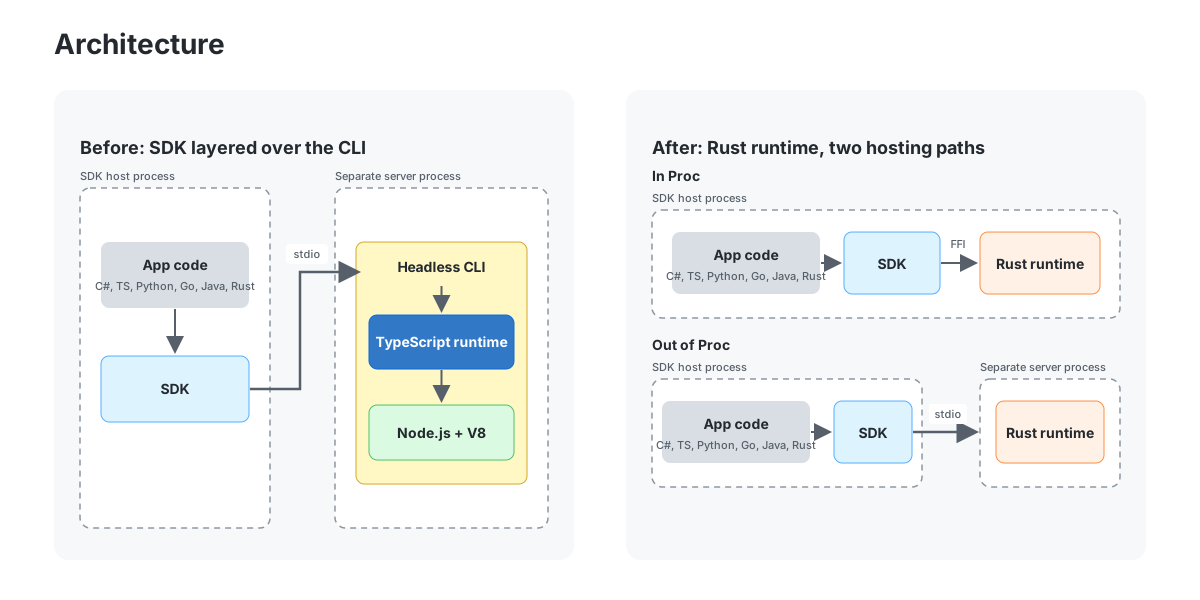
For a long time, the idea of rewriting a massive codebase to improve its performance felt like a Sisyphean task, a labor of futility that was simply not affordable. The sheer volume of work required to migrate millions of lines of logic from one language to another created a barrier so high that it seemed insurmountable for anything but the most trivial of projects. We assumed that the cost of translation outweighed the benefits, that the inevitable bugs and the months of context switching would drain more resources than they would save. But the landscape of software development has shifted beneath our feet, and the advent of AI agents has turned that impossible mountain into a manageable climb.
The migration of the GitHub Copilot agent runtime to Rust serves as the definitive proof that this new reality is here. This wasn't a small refactor; it was a complete resurrection of a system built on over 800,000 lines of production-grade Rust. Before the integration of agents, such a port was a commercial non-starter, but the ability to generate, review, and refine code in real-time changed the equation. It allowed our team to tackle the complexity that would have previously required a battalion of senior engineers, effectively compressing years of work into a manageable sprint.
What makes this particular rewrite so significant is the sheer scale of the runtime itself. The Copilot agent is the brain behind the scenes, orchestrating complex tasks that span from local development environments to massive cloud infrastructure. Moving this cognitive load into Rust was not just a quest for memory efficiency or faster compilation times, though those were certainly byproducts. The primary goal was to build a system so robust and predictable that it could handle the chaotic nature of human coding without introducing its own fragility. Rust's ownership model provided the safety net needed to run these critical operations at the edge, where reliability is non-negotiable.
The narrative of this migration is one of collaboration between human intuition and machine precision. It required a unique workflow where developers would identify the architectural boundaries and the critical paths, and the agents would handle the intricate details of translation, pattern matching, and error handling. This synergy revealed that the biggest bottleneck in large-scale refactoring is rarely the code itself, but rather the cognitive load of maintaining context. By offloading the mechanical drudgery of porting to the agents, the human team could focus on the high-level design and the subtle nuances of the new language's ecosystem.
Ultimately, this rewrite redefines what is possible in enterprise software development. It demonstrates that the barriers to entry for massive infrastructure projects are no longer defined by the sheer volume of code, but by the sophistication of our tools and our willingness to trust them. The 800,000 lines of Rust that now power the Copilot runtime stand as a testament to a new era where AI agents act not just as assistants, but as co-architects capable of steering the most complex digital voyages. We have proven that the impossible is merely a matter of waiting for the right tools to arrive, and then having the courage to build with them.
On Bluesky? Meet HomeSky.
Follower analytics, a growth toolkit, scheduling and AI posting — built for Bluesky. Connect your account and use everything free for 60 days.
Try HomeSky free →