Migrating the GitHub Copilot runtime to Rust, using Copilot
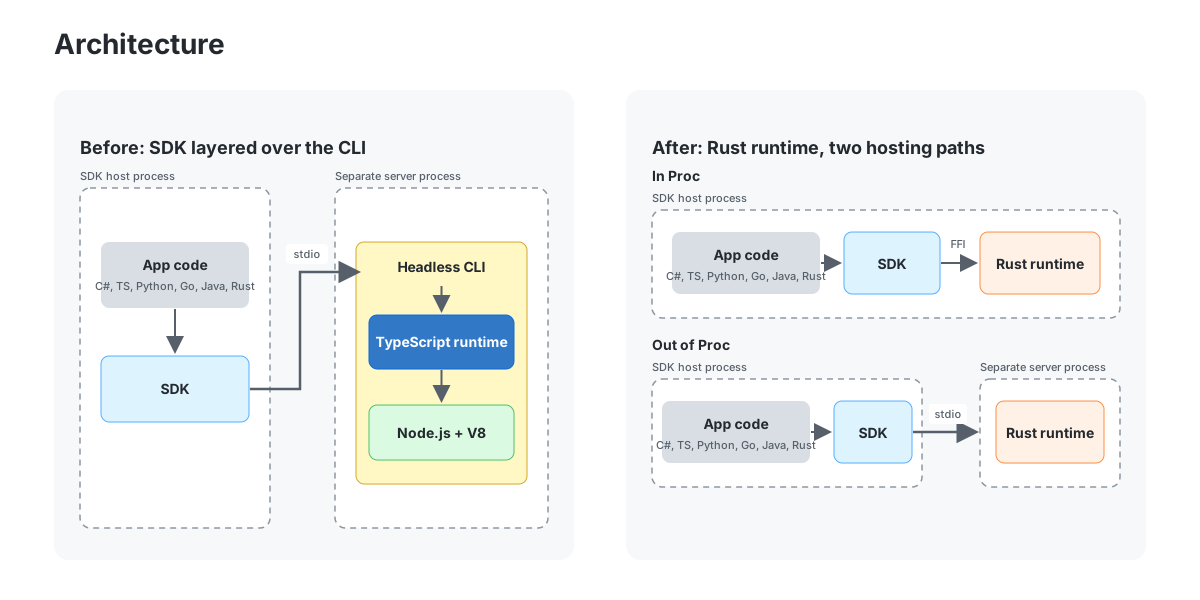
For years, the architecture of the GitHub Copilot runtime was a testament to the era before true generative agents could handle massive scale. It was a monolith of legacy code, written in languages that were powerful but cumbersome to modernize. The decision to rewrite this system in Rust wasn't just a technical preference for memory safety or speed; it was a survival mechanism. The old runtime was choking on its own complexity, and the cost of keeping it alive was becoming prohibitive in terms of both engineering hours and operational risk. This migration project stands as a unique case study because, prior to the advent of sophisticated AI agents, such a rewrite of this magnitude would have been deemed economically unviable.
The sheer scale of the undertaking is staggering, involving approximately 800,000 lines of production-grade Rust code. Porting a system of this size is rarely a linear process of line-by-line translation; it is a chaotic dance of refactoring, abstraction, and reconstruction. Imagine the sheer volume of mental gymnastics required to ensure that a line of C++ or Go in the old world maps perfectly to a safe, efficient Rust construct in the new, without introducing subtle bugs that could break the entire ecosystem. The engineering team essentially had to build a new plane while flying it, only this time, they were doing it in a language designed to prevent crashes from happening in the first place.
What makes this story particularly fascinating is that the very tool being migrated was used to build the migration. It is a recursive loop of innovation where the Copilot agent runtime was leveraged to write the code for the next generation of Copilot. This created a feedback loop of unprecedented efficiency, where the AI didn't just suggest snippets; it understood the architectural intent, the error patterns, and the performance constraints of the new language. It felt like having a co-pilot who not only knew the flight manual but could also rewrite the manual itself while the plane was in turbulence.
The implications for the industry are profound. This project demonstrates that the barrier to large-scale system rewrites has shifted dramatically. In the past, companies hesitated to touch their core infrastructure because the human cost of rewriting millions of lines was too high. Now, with the assistance of agents, the equation changes. The "affordable" threshold for modernization has expanded, allowing organizations to tackle legacy debt with a confidence that was simply not there a few years ago. The Rust implementation is not just faster or safer; it represents a new paradigm of software evolution.
Ultimately, this migration is more than a technical victory; it is a validation of a new era in software development. It proves that the integration of AI agents into the core workflow can transform what was once a Herculean task into a manageable, albeit complex, engineering challenge. The 800,000 lines of Rust code sitting in production today are a monument to this shift—a physical manifestation of the idea that the tools we use to build our future can evolve faster than the systems they are tasked with improving. The old runtime is gone, replaced by something leaner, safer, and infinitely more capable, all thanks to a collaboration between human engineers and intelligent machines.
On Bluesky? Meet HomeSky.
Follower analytics, a growth toolkit, scheduling and AI posting — built for Bluesky. Connect your account and use everything free for 60 days.
Try HomeSky free →