Researchers Measure the Environment Where the First Supermassive Black Holes Formed
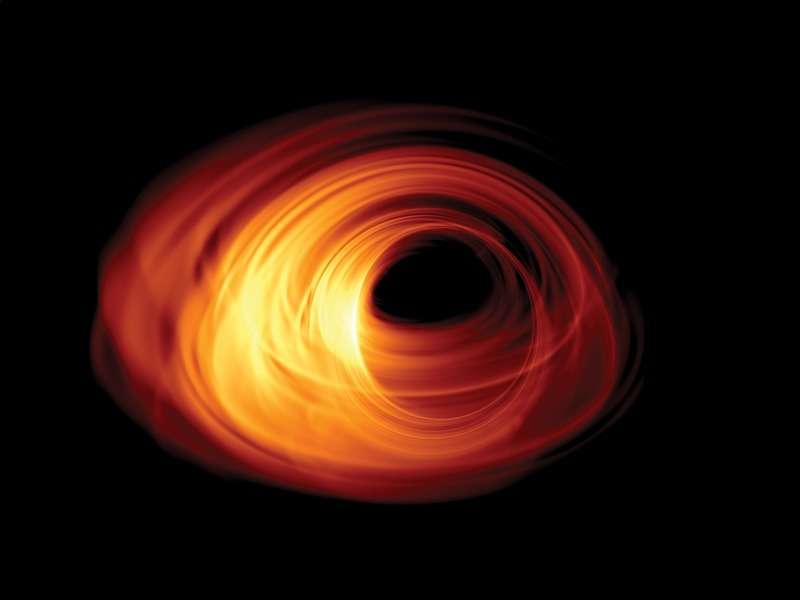
Imagine looking back at the infant universe, a time when the cosmos was a relatively cool and dark place, yet somehow, colossal black holes were already growing in the centers of galaxies. It is a profound paradox that defies our intuitive understanding of time and scale. How could these voracious monsters, with masses millions or even billions of times that of our Sun, form so rapidly in the first billion years after the Big Bang? Standard theory suggests that black holes grow by accreting matter over eons, but the early universe simply didn't have that much time. The answer, researchers suggest, lies not in slow accretion, but in a radical shortcut known as the direct-collapse scenario.
This hypothesis posits that under very specific and rare conditions, a massive cloud of gas could collapse directly into a black hole without forming a star first. Normally, a cloud of gas will fragment into stars as it condenses, but in this unique environment, the formation of stars is suppressed. The result is a "seeding" event where a primordial black hole forms instantly with a mass of thousands of solar weights, ready to grow into the supermassive behemoths we observe today. It is a cosmic lottery, requiring the right ingredients to happen just once, yet the evidence suggests it did happen more often than we once dared to hope.
The key to unlocking this mystery lies in the delicate chemistry of the early universe, specifically the behavior of carbon. In the first few hundred million years, the universe was devoid of heavy elements like carbon, which is crucial for cooling gas clouds. Without carbon, gas cannot shed heat efficiently as it contracts. However, astronomers have discovered that even trace amounts of carbon, if present in the right ratio, can actually prevent the cloud from fragmenting. When carbon is present but the hydrogen is ionized by a nearby ultraviolet source, it creates a perfect storm: the gas heats up enough to resist fragmentation but not enough to explode, allowing it to collapse as a single, monolithic entity.
Finding the right environment for these direct-collapse events is akin to finding a needle in a cosmic haystack. The new study narrows down the search by identifying the precise atmospheric conditions required. The host galaxies must be metal-poor, devoid of the heavy elements formed in previous generations of stars, and bathed in intense ultraviolet radiation that suppresses star formation while allowing the gas to cool slowly enough to collapse. This creates a narrow window of opportunity, a fleeting moment in the chaotic history of the cosmos where the laws of physics conspire to birth a giant rather than a star.
Why does this matter? Because it fundamentally changes our understanding of the early universe's architecture. If the direct-collapse scenario is correct, it explains how the "seeds" of supermassive black holes were large enough to grow so quickly. It suggests that the universe was capable of producing these giants not through gradual accumulation, but through a sudden, dramatic leap in complexity. It is a reminder that nature often finds the path of least resistance, even if that path requires the most improbable conditions.
As we continue to refine our models and analyze data from telescopes like James Webb, the picture becomes clearer. We are moving from a realm of speculation to one of observation, piecing together the puzzle of how the first giants formed. The universe may be stranger and more efficient than we ever imagined, hiding its greatest secrets in the quiet, dark corners of its earliest days, waiting for us to finally understand the rules that governed its birth.
On Bluesky? Meet HomeSky.
Follower analytics, a growth toolkit, scheduling and AI posting — built for Bluesky. Connect your account and use everything free for 60 days.
Try HomeSky free →