Migrating the GitHub Copilot runtime to Rust, using Copilot
There was a time when rewriting a massive codebase was a project reserved for armies of engineers working for months, armed with spreadsheets and a healthy dose of caffeine. The sheer volume of logic, the intricate dependencies, and the subtle state management made the idea of porting a complex system to a new language feel like asking a human to climb Mount Everest while wearing a spacesuit. For the GitHub Copilot runtime, a beast composed of 800,000 lines of production code, this was the impossible dream that defined the limitations of traditional development. We assumed that such a migration was an unaffordable luxury, a cost that simply didn't fit within any reasonable timeline or budget.
That assumption changed the moment artificial intelligence agents entered the picture. The Copilot team didn't just hire more developers; they hired a swarm of digital collaborators capable of understanding context, suggesting refactors, and generating boilerplate with a speed that defied human endurance. By leveraging Copilot to write the Rust code itself, the team flipped the script on the entire engineering paradigm. Instead of humans struggling to translate idioms from one language to another, the team used the very tool they were building to architect its own foundation. It was a meta-problem, a recursive loop where the agent was the primary actor in its own migration, turning a potential decade-long slog into a manageable sprint.
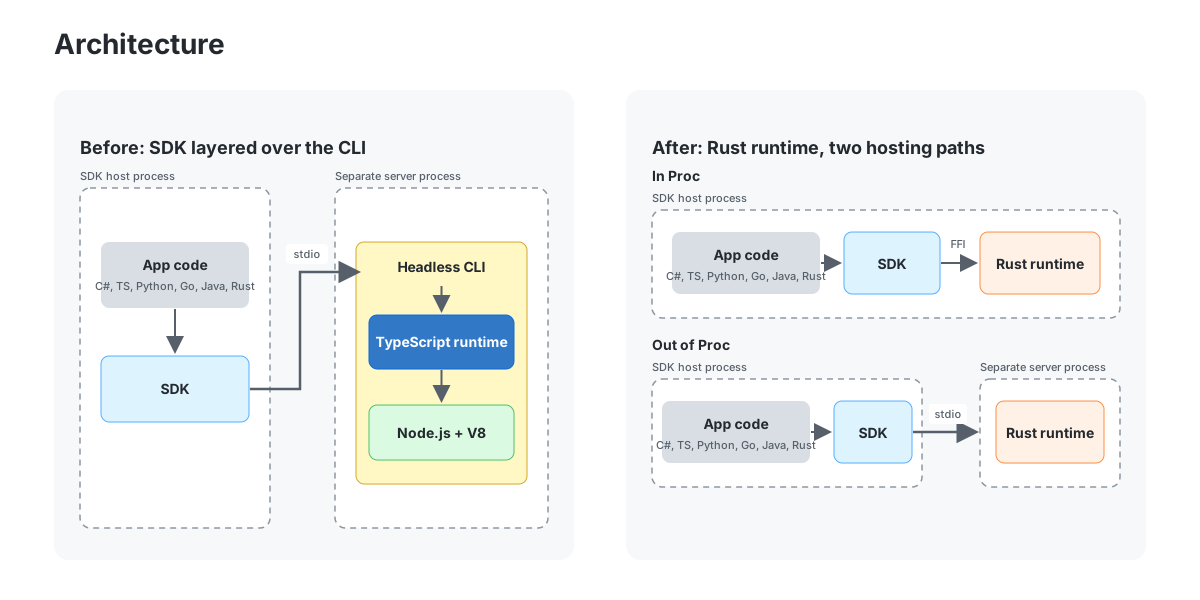
The transition to Rust wasn't just about swapping syntax; it was about fundamentally altering the architecture of the runtime to be safer, faster, and more resilient. Rust's strict memory safety guarantees offered a shield against the kinds of runtime errors that plagued the previous implementation, eliminating entire classes of bugs that could have destabilized the service at scale. Porting millions of lines of logic required a level of precision and foresight that traditional methods might have missed, but the AI agent could analyze the existing behavior, predict the implications of changes, and propose solutions that aligned perfectly with the original intent. The result was a system that felt lighter, more robust, and capable of handling the immense load of global developers relying on its suggestions.
What makes this achievement particularly fascinating is the feedback loop it created. As the Rust version was built, the team could verify the agent's work against the original behavior, refining the prompts and the agent's capabilities in real-time. It demonstrated that the future of large-scale software development isn't just about automating repetitive tasks, but about empowering agents to tackle high-stakes architectural migrations. The 800,000 lines of Rust code standing there today are not just a testament to the power of the language, but to the effectiveness of the agents that wrote them. It proves that the barrier to entry for massive system rewrites has been significantly lowered, opening the door for other teams to attempt similar feats with confidence.
Ultimately, the story of the Copilot runtime migration is a story about trust and iteration. Trusting an AI to handle the most critical parts of a production system requires a nuanced approach, one where the human engineers remain the architects while the agents serve as the master builders. The result is a system that is not only technically superior but also a blueprint for how the industry will approach infrastructure in the coming years. The journey from an unaffordable impossibility to a standard practice is over, and the new era of intelligent, agent-driven engineering has begun.
On Bluesky? Meet HomeSky.
Follower analytics, a growth toolkit, scheduling and AI posting — built for Bluesky. Connect your account and use everything free for 60 days.
Try HomeSky free →