Migrating the GitHub Copilot runtime to Rust, using Copilot
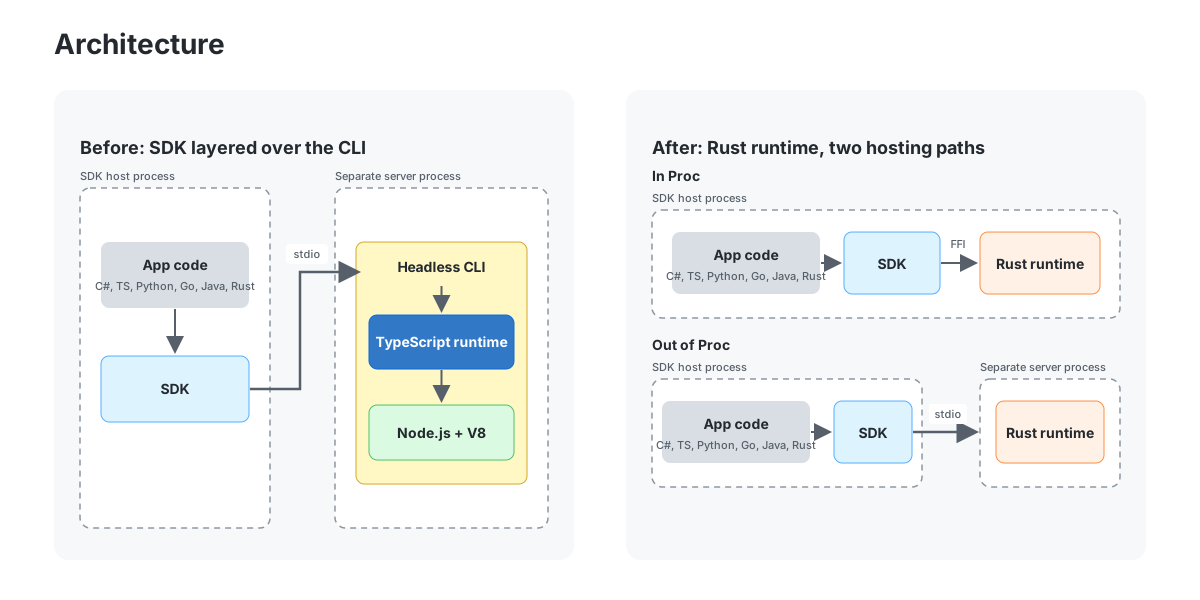
Porting the GitHub Copilot agent runtime to Rust felt less like a standard software migration and more like attempting to rebuild a skyscraper while living inside it. For years, the decision to rewrite this massive codebase was considered financially and logistically impossible; the sheer volume of work required to translate 800,000 lines of production code made the project seem like a fool's errand. In the old paradigm of software development, such an undertaking demanded armies of engineers, years of downtime, and budgets that could have bought a small country. The sheer scale of the task created a ceiling that seemed unbreakable until the introduction of AI agents changed the fundamental economics of engineering.
The real breakthrough came from a simple, almost absurd realization: why not use the very system we were building to build itself? By leveraging Copilot to generate the Rust code, we turned the development process into a recursive loop of creation and refinement. This wasn't just about using autocomplete to speed up typing; it was about deploying an autonomous workforce capable of understanding the intricate architecture of the existing runtime and translating it into a new, high-performance language. The result was a paradigm shift where the tool used for writing the code became the primary architect of the rewrite, fundamentally altering the relationship between human intent and machine execution.
The journey wasn't without its hiccups, as the gap between generating syntactically correct Rust and producing robust, production-ready software is vast. Early attempts revealed that the agent struggled with the subtle nuances of concurrency and memory safety that Rust demands, often producing code that compiled but behaved unpredictably under load. We had to fine-tune our approach, moving from a "generate and hope" strategy to a rigorous cycle of generation, automated testing, and human-in-the-loop validation. This hybrid model allowed us to catch logical errors that standard static analysis missed while ensuring that the new runtime maintained the reliability standards that millions of developers depend on daily.
Looking at the metrics, the transformation was staggering. The rewrite, which would have taken a team of dozens perhaps years to complete, was accomplished in a fraction of the time and cost. The new Rust runtime delivered significant performance gains, reducing latency and resource consumption across the board, proving that the migration wasn't just a technical exercise but a strategic victory. It demonstrated that when the right tools are applied to the right problems, the perceived immovable objects of software engineering can become movable ones, opening up possibilities that were previously dismissed as fantasy.
Ultimately, this project serves as a testament to the accelerating pace of technological evolution. It shows that the barriers to entry for massive-scale infrastructure projects are rapidly dissolving, not because the complexity of the systems is decreasing, but because our ability to manipulate and generate that complexity is increasing exponentially. The migration of the Copilot runtime to Rust is not just a story of code translation; it is a microcosm of a larger shift in how we think about building the digital world, where the most difficult problems become solvable simply because we have better tools to tackle them.
On Bluesky? Meet HomeSky.
Follower analytics, a growth toolkit, scheduling and AI posting — built for Bluesky. Connect your account and use everything free for 60 days.
Try HomeSky free →