Migrating the GitHub Copilot runtime to Rust, using Copilot
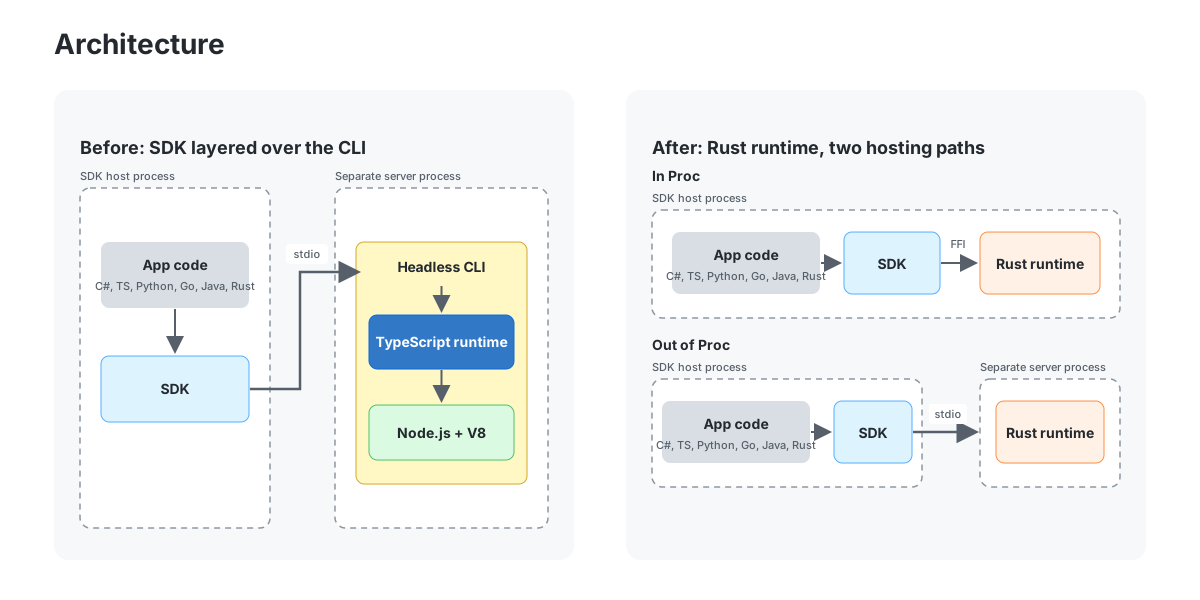
For years, the idea of rewriting a massive, production-grade AI runtime in Rust seemed like a pipe dream, a theoretical exercise reserved for white papers rather than engineering reality. Before the arrival of autonomous coding agents, the sheer cognitive load required to map eight hundred thousand lines of complex Go logic to idiomatic Rust was simply too high for any single human team to undertake without a decade of dedicated refactoring. We were staring down an impossible hill, where the risk of introducing regressions or breaking subtle stateful interactions in the Copilot agent made the status quo feel safe, even if it was holding us back from the performance and safety guarantees that Rust promises.
Then, the paradigm shifted with the integration of Copilot itself into the development workflow. What began as a small experiment to offload boilerplate generation quickly spiraled into a full-scale architectural overhaul, where the AI didn't just write helper functions but actively guided the migration strategy, suggesting type signatures, identifying potential panic points, and proposing parallelization patterns that the original developers might have missed. This was not merely a mechanical translation; it was a collaboration where the machine acted as a senior architect, constantly questioning assumptions and forcing the human team to engage with the deeper structural constraints of the new language.
The scale of the undertaking was staggering, involving not just the core runtime but also the intricate web of integrations with external services, the complex state management required for long-running agent sessions, and the nuanced error handling protocols that differentiate between transient network issues and fatal logic errors. Every component had to be re-examined through the lens of Rust's ownership model, a fundamental shift that demanded a rigorous rethinking of how data flows through the system. The friction was intense, with frequent deadlocks and borrow checker errors threatening to derail progress, yet the clarity gained from these failures provided a unique opportunity to harden the codebase in ways that were impossible in the previous architecture.
What emerged from this process was a system that was not only more performant and secure but also fundamentally more maintainable, with a memory footprint significantly reduced and the potential for real-time responsiveness that was previously unattainable. The journey revealed that while the initial cost in terms of developer time was substantial, the long-term dividend was a platform that could scale more efficiently and adapt more quickly to new AI models and inference strategies. It proved that with the right tools and a collaborative approach between human intent and machine capability, even the most daunting legacy systems could be modernized without the usual paralysis of analysis or the fear of breaking things.
Looking back, the migration stands as a testament to how rapidly the capabilities of AI-assisted development have evolved, turning what was once a multi-year project into a focused, high-velocity sprint that delivered tangible results. The transition to Rust forced us to confront the limitations of our old ways of thinking about concurrency and resource management, resulting in a cleaner, more robust foundation for the next generation of AI agents. This work didn't just change the code; it changed how the engineering culture approached problem-solving, embedding a mindset of rigorous correctness and performance optimization into the very DNA of the team.
On Bluesky? Meet HomeSky.
Follower analytics, a growth toolkit, scheduling and AI posting — built for Bluesky. Connect your account and use everything free for 60 days.
Try HomeSky free →