Migrating the GitHub Copilot runtime to Rust, using Copilot
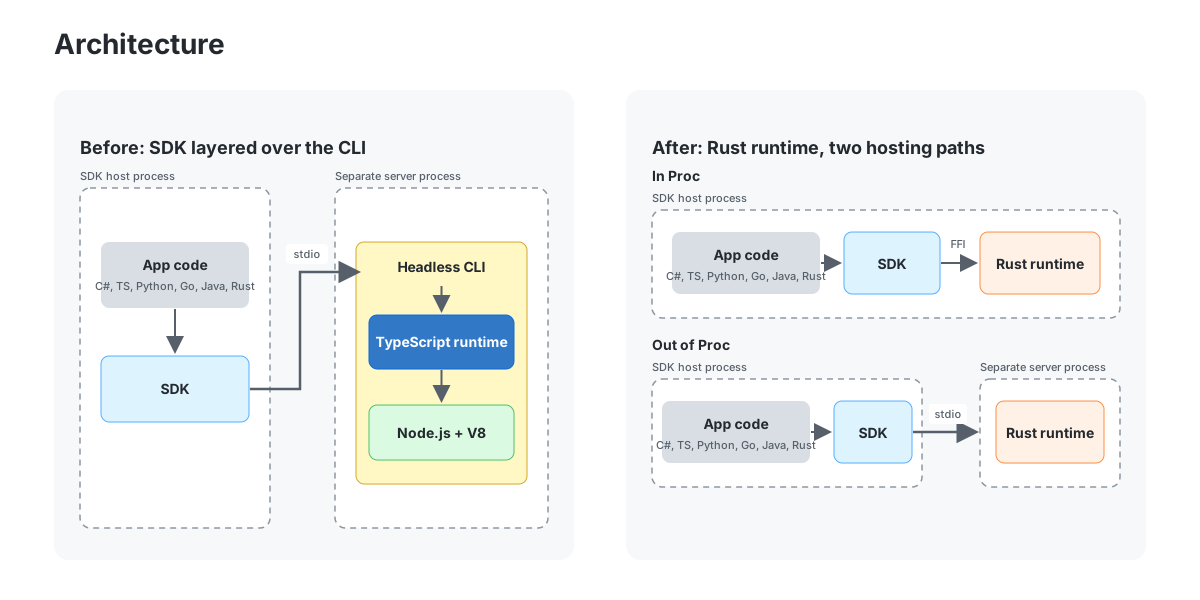
Before the arrival of AI agents, rewriting a codebase of this magnitude was a financial and logistical impossibility. We were staring down an abyss of 800,000 lines of Go, a massive legacy system that underpinned the entire Copilot runtime. The cost in man-hours alone was prohibitive; it would have required a dedicated army of senior engineers for years, a resource drain that made no business sense. The very idea of tackling a rewrite of this scale without a force multiplier was not just risky; it was a non-starter.
That changed when we looked at Rust not just as a language, but as a partner in the process. Our goal was to migrate this monolithic runtime to Rust to gain the benefits of memory safety and performance, but the real breakthrough came from asking Copilot to do the heavy lifting. We didn't just want code completion; we needed Copilot to act as a junior engineer who never slept, capable of understanding the high-level architecture well enough to generate the scaffolding for thousands of functions.
The workflow became a dance between human intent and machine generation. We would define the Rust interfaces and the desired behavior, then feed the corresponding Go implementations back to the LLM. Copilot would analyze the logic, translate the patterns, and write the initial Rust code. What emerged was startlingly effective. It wasn't just syntactic translation; the agent understood the semantics, preserving the intricate error handling and state management logic that had evolved over years of development.
However, the process was far from seamless. There were moments where the generated code felt brittle or missed subtle edge cases embedded in the original logic. This is where the human element remained crucial. Our engineers acted as conductors, reviewing the orchestra of generated code, fixing the dissonance, and guiding the AI back on track. It was an iterative loop of generation, review, correction, and regeneration that slowly chipped away at the legacy codebase, replacing it with a modern, safe foundation.
Looking at the final result, the shift is profound. We didn't just port the code; we transformed it. The new Rust runtime is faster, safer, and easier to maintain, but the journey there was the real story. It proved that large-scale refactoring is no longer a purely manual endeavor. With the right tools, a single team can execute a project that would have previously required a massive organization, redefining what is possible in software engineering.
This migration stands as a testament to the maturation of AI in development. It moves beyond the hype of autocomplete and into the realm of architectural transformation. We have shown that agents can handle the grunt work of massive codebases, allowing developers to focus on design and innovation rather than the tedious mechanics of translation. The future of large-scale software evolution is here, and it is being written, line by line, with the help of Copilot.
On Bluesky? Meet HomeSky.
Follower analytics, a growth toolkit, scheduling and AI posting — built for Bluesky. Connect your account and use everything free for 60 days.
Try HomeSky free →