Migrating the GitHub Copilot runtime to Rust, using Copilot
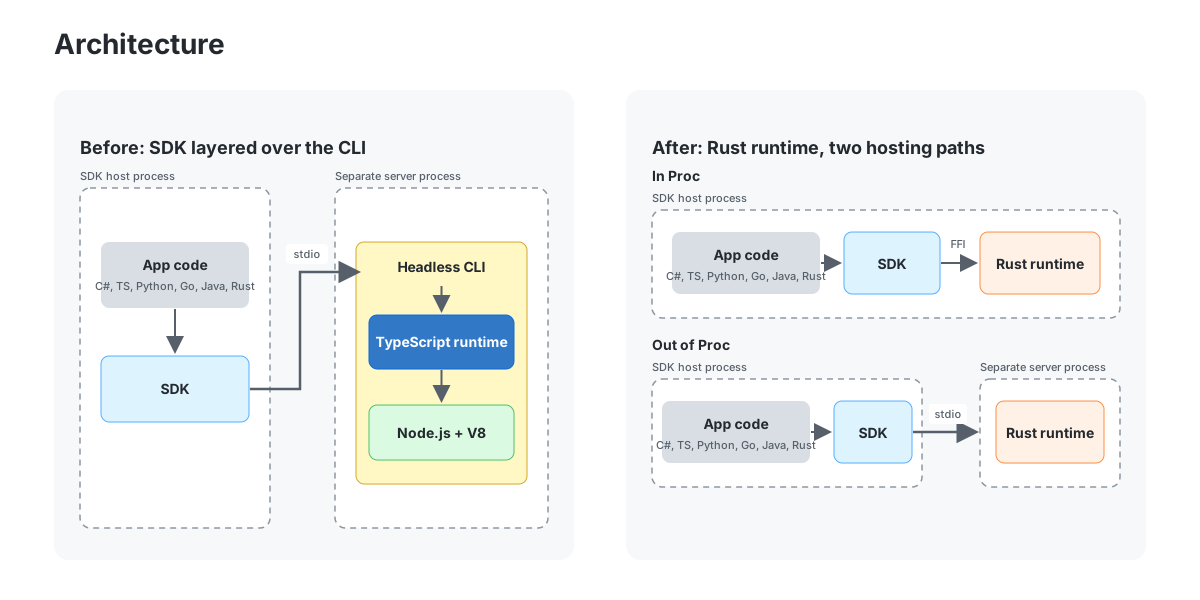
Before the rise of autonomous agents, a rewrite of this magnitude was simply not affordable. The GitHub Copilot runtime, a critical piece of infrastructure powering code generation for millions of developers, was originally built in a language ecosystem that offered speed of development but lacked the long-term performance and memory efficiency required for its evolving scale. The decision to migrate this complex system to Rust wasn't just a technical refactor; it was a strategic necessity to ensure the tool remained robust as its own complexity grew, turning a potential liability into a high-performance asset.
Porting a system comprising 800,000 lines of production code is a monumental task that defies the notion of a simple "lift and shift." It requires a deep, line-by-line understanding of the existing logic, a rigorous translation of idioms from the original language to Rust's strict ownership model, and a complete rethinking of how concurrency is handled. The sheer volume of code means that human error is inevitable without a safety net, and that is exactly where the irony and the power of using Copilot itself lies: leveraging the very system being built to facilitate its own reinvention.
The process was less about blindly trusting the AI to generate correct Rust code and more about a collaborative dance between developer intent and machine capability. We fed the existing architecture and logic into Copilot, treating it as a hyper-attentive pair programmer who never slept and had instant access to the entire codebase. The goal was to guide the agent through the translation, correcting its hallucinations and refining its suggestions until the generated code met the stringent safety and performance guarantees that Rust demands. This hybrid approach allowed us to move at a pace that would have been impossible with a purely manual team effort.
The results speak for themselves. The Rust implementation didn't just replicate the functionality of the original runtime; it significantly reduced the memory footprint and improved the latency of code generation responses. By enforcing memory safety at the compile time, we eliminated an entire class of runtime bugs that were previously costly to debug and deploy. The migration proved that even the most intricate, legacy-heavy systems could be modernized with the right tools, turning a decade of accumulated technical debt into a foundation for future innovation.
This endeavor serves as a case study in the changing landscape of software development. It demonstrates that the boundary between tool and builder is blurring, where the software you use to build the next generation of software is becoming indistinguishable from the architects themselves. The successful migration of the Copilot runtime to Rust validates the potential of AI agents to handle the heavy lifting of enterprise-scale refactoring, freeing human engineers to focus on high-level design and problem-solving rather than the drudgery of syntax and boilerplate.
Ultimately, the rewrite was affordable only because we had the right partner at the table. By marrying the precision of Rust with the generative power of Copilot, we achieved a transformation that was previously out of reach. The 800,000 lines of new code are not just a technical achievement; they are a testament to what is possible when human oversight and artificial intelligence work in unison to push the boundaries of what software can do.
On Bluesky? Meet HomeSky.
Follower analytics, a growth toolkit, scheduling and AI posting — built for Bluesky. Connect your account and use everything free for 60 days.
Try HomeSky free →