Migrating the GitHub Copilot runtime to Rust, using Copilot
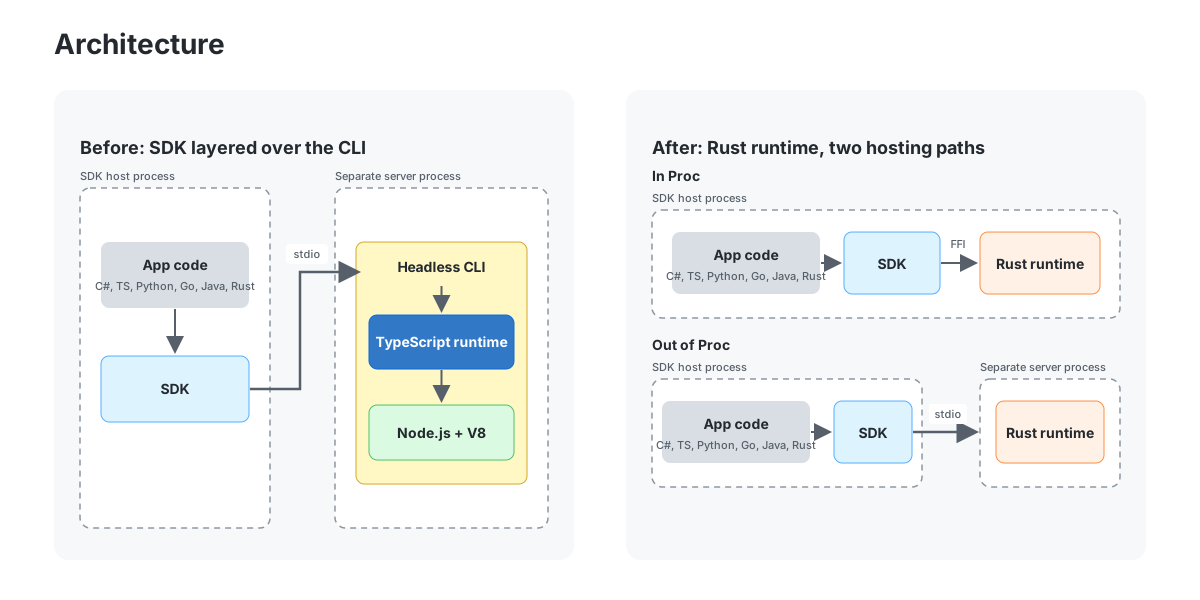
There was a time when migrating a critical infrastructure component from Python to Rust was a high-risk, high-cost endeavor reserved for teams with deep pockets and a tolerance for months of downtime. The fear wasn't just about the learning curve or the sheer volume of code; it was the invisible tax of context switching, the risk of introducing subtle bugs during the rewrite, and the opportunity cost of engineering resources staring at a compiler that complains in a language they didn't speak. For the GitHub Copilot runtime, a rewrite of this magnitude was previously considered a luxury we simply couldn't afford.
That calculus changed the day we decided to ask the very system we were building to help us rewrite itself. By leveraging Copilot agents to handle the heavy lifting of boilerplate generation, type inference, and even complex logic translation, we fundamentally altered the equation of technical debt. It wasn't a magic wand that solved every problem instantly, nor did it eliminate the need for rigorous human oversight, but it did transform a project that would have taken six months into a sprint that felt remarkably sustainable.
Porting the runtime to 800,000 lines of production Rust was less about syntax translation and more about architectural rigor. Rust demands a level of precision that leaves no room for the "maybe" that plagues dynamic languages. Every pointer must be accounted for, every memory allocation justified, and every borrow checked with mathematical certainty. The initial phase was brutal; the AI would often generate code that compiled but failed to handle edge cases in the way our legacy Python implementation did, forcing a constant loop of critique and refinement where the developer had to act as the strict editor rather than the sole author.
The true measure of success wasn't just the final line count or the benchmark numbers, though the performance gains were undeniable. The real victory was psychological and cultural. The team that undertook the migration found that the friction of learning Rust's ownership model was significantly reduced when the AI could provide immediate, context-aware examples of safe idioms. We stopped fighting the language and started collaborating with it, turning what should have been a barrier into a scaffold that allowed us to build a safer, faster, and more maintainable system at scale.
Looking back, the decision to use Copilot to migrate Copilot feels almost circular, yet it is the most logical path forward for an AI-native tool. It validates the thesis that the next generation of software development tools won't just assist in writing code; they will be the architects of the migration itself. We are no longer just writing software; we are evolving the very machinery that writes it, creating a feedback loop where the tool becomes smarter, safer, and more efficient with every line of Rust it helps generate.
On Bluesky? Meet HomeSky.
Follower analytics, a growth toolkit, scheduling and AI posting — built for Bluesky. Connect your account and use everything free for 60 days.
Try HomeSky free →