Migrating the GitHub Copilot runtime to Rust, using Copilot
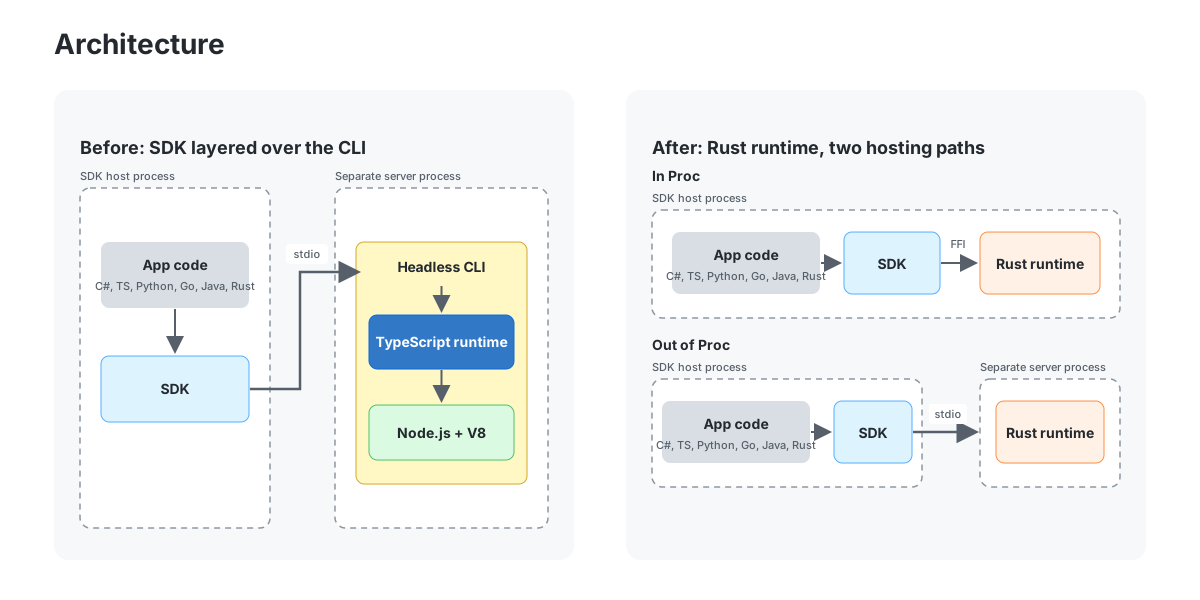
For years, the idea of rewriting a massive, battle-tested codebase with the very tools it manages felt like a paradox. The GitHub Copilot runtime, a system managing over 800,000 lines of critical infrastructure, was originally written in Python. It was reliable, it worked, and frankly, it was just fine. But "just fine" meant it was tethered to the limitations of interpreted execution, memory overhead, and the sheer verbosity required to maintain a monolithic state machine. The decision to migrate to Rust wasn't just a quest for performance; it was a recognition that the scale of the problem had outgrown the tooling of the past.
The challenge wasn't merely translating syntax from Python to Rust; it was translating intent. We had to ensure that the agent logic, the reasoning loops, and the orchestration of thousands of concurrent requests remained intact while simultaneously tightening memory safety guarantees that were previously an afterthought. In the past, a rewrite of this magnitude would have required armies of engineers, months of downtime, and a level of risk that made leadership hesitate. We would have been forced to build a new system alongside the old, a legacy burden that would eventually swallow our resources.
Enter Copilot. The irony is palpable, yet the utility is undeniable. We asked the AI agent to generate the Rust code for our core runtime, effectively using Copilot to rewrite Copilot. It wasn't magic, but it was close. The agent didn't just spit out boilerplate; it understood the architectural patterns, the specific error handling strategies we had honed over years, and the nuanced data structures that made the system tick. It generated thousands of files, creating a draft that was far more coherent than any initial skeleton code would have been, giving us a head start that would have taken human teams weeks to achieve.
The transition, however, was not without its friction. The AI-generated code required rigorous human validation. We found that while Copilot excelled at structural implementation, it occasionally struggled with the deep context of our specific internal APIs and the subtle edge cases that had been documented only in legacy comments or tribal knowledge. Our team acted as conductors, refining the orchestra of code that the AI initially tried to play by ear. We spent significant time reviewing the generated modules, ensuring that the strict ownership model of Rust was applied correctly without sacrificing the fluidity of the agent's decision-making process.
Porting the runtime to Rust yielded results that went beyond the theoretical benefits of compiled speed. The memory footprint shrank dramatically, allowing us to spin up more agents on the same hardware budget. Latency dropped, meaning the feedback loop for developers using the tools became instantaneous rather than sluggish. More importantly, the psychological shift was profound; by writing the critical infrastructure in a language known for its safety, we reduced the cognitive load on our remaining engineers, freeing them to focus on innovation rather than debugging race conditions or managing garbage collection pauses.
This migration stands as a testament to a changing paradigm in software engineering. It proves that the very tools we use to build our applications can, in some ways, participate in their own evolution. We didn't just move lines of code; we leveraged the collective intelligence of modern AI to tackle a legacy problem that once seemed insurmountable. The result is a faster, safer, and more scalable runtime that continues to empower millions of developers, all written with the help of the very system it now powers.
On Bluesky? Meet HomeSky.
Follower analytics, a growth toolkit, scheduling and AI posting — built for Bluesky. Connect your account and use everything free for 60 days.
Try HomeSky free →