On this day in space! Sept. 6, 1947: The US Navy launches 1st V-2 rocket at sea in ballistic missile test
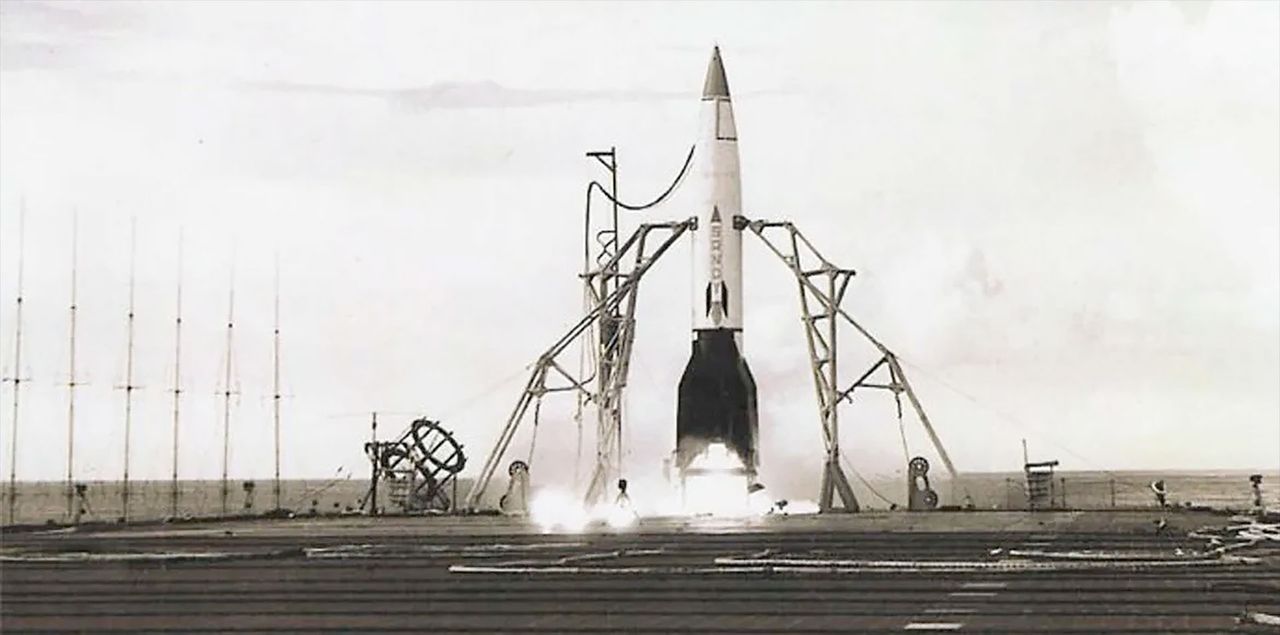
On September 6, 1947, the Atlantic Ocean became the stage for a moment that would fundamentally alter the trajectory of human history, not because of the roar of engines or the flash of explosions, but because of where the launch took place. For decades, humanity had looked up at the heavens, dreaming of reaching them from the solid, unyielding ground. Yet, on this specific day, the United States Navy turned the U.S.S. Langley into a moving platform, firing a captured German V-2 rocket from the deck of an aircraft carrier. This was not merely a test of propulsion; it was a proof of concept that validated the most radical idea in orbital mechanics: that a rocket did not need to stand on the Earth to fly toward it.
The context of this event is steeped in the shadow of World War II and the frantic scramble of the early Cold War. The V-2, originally designed by Wernher von Braun and his team in Germany, was the first guided ballistic missile to reach space, achieving an altitude of over 80 miles in its 1942 debut. After the war, the United States secured the team and the technology, seeing immense strategic value in a weapon that could bypass anti-aircraft defenses and deliver payloads across oceans. However, the Navy realized something even more profound: if a rocket could launch from a ship, it could theoretically launch anywhere the ship could go. This shifted the paradigm from fixed silos to mobile platforms, effectively turning the entire coastline and the high seas into potential launch corridors.
The technical implications of firing from a moving deck are staggering, even by today's standards. A rocket launched from land must account for the rotation of the Earth and the Coriolis effect, which can cause significant drift at high altitudes. A rocket launched from a carrier, moving at 25 knots or more, adds a vector of its own, requiring the guidance systems of 1947 to be incredibly precise to counteract the ship's roll, pitch, and heave. The U.S. Navy's success on that day demonstrated that the platform's motion could actually assist in achieving specific orbital inclinations, a principle that would later become the backbone of space elevators and naval orbital launches. It proved that the ocean was not just a barrier to be crossed, but a resource to be utilized.
This event marked the birth of the Navy's Space Launch capability, a lineage that stretches directly to the present day. Decades later, when NASA found itself struggling with the high costs and logistical nightmares of land-based launches, the answer lay in the very experiment performed by the U.S. Navy in 1947. The concept of a Mobile Launcher Unit, capable of traveling to the sea for a launch, was directly inspired by this early carrier test. It allowed for a degree of secrecy and flexibility that static facilities could never offer, ensuring that the ability to launch into space was never tied to a single geographic location that could be targeted or compromised.
Ultimately, the launch of the V-2 from the U.S.S. Langley was more than a military exercise; it was a declaration of human ambition. It signaled that we were no longer bound by the geography of our planet. We could launch from the center of the ocean, from the edge of the continent, or from a ship cruising in the middle of the Pacific. That day, the horizon expanded, and the idea of space became accessible, not as a distant destination reserved for the lucky few at fixed launch pads, but as a realm we could access from anywhere we chose to be. The V-2 rose into the sky, but it was the concept of the mobile launch that truly took flight, setting the stage for the future of space exploration.