3I/ATLAS Has An Extreme Taste For Heavy Water
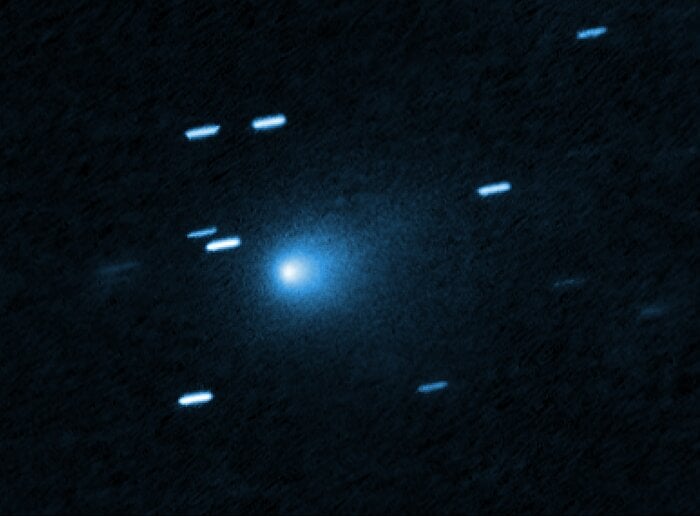
When humanity first cataloged our cosmic neighbors, we found two interstellar wanderers: 1I/'Oumuamua and 2I/Borisov. Now, in the wake of a discovery in July 2025, we stand on the precipice of a third encounter, yet this new visitor, designated 3I/ATLAS, refuses to play by the rules we established for the previous two. It is not merely passing through; it is carrying a chemical signature so distinct that it challenges our fundamental understanding of where it came from. As the object traverses our solar system, a quiet revolution is happening in the data streams of our most powerful telescopes, revealing a comet that tastes unlike anything we have ever measured in our own back garden.
The peculiar nature of 3I/ATLAS lies in its isotopic composition, specifically regarding deuterium, the heavy isotope of hydrogen. While comets from our solar system typically exhibit a deuterium-to-hydrogen ratio that aligns with the history of our protoplanetary disk, 3I/ATLAS displays a staggering anomaly. A new paper submitted to The Astrophysical Journal Letters by Kenji Furuya of the RIKEN Pioneering Research Institute in Japan and his team suggests that this discrepancy is not an observational error but a fundamental clue. The object appears to be hoarding heavy water with a ferocity that defies the standard formation models of our neighborhood, hinting at a birth environment radically different from the cold, gas-rich clouds that birthed our own sun.
This is not just a matter of academic curiosity; it is a window into the galactic chemistry that we have been blind to. By analyzing the ratios of these isotopes, astronomers can reconstruct the thermal history of the star system where this comet was forged. If the heavy water ratio is truly extreme, as the pre-print data suggests, it implies that 3I/ATLAS formed in a region of its home system where temperatures were higher than expected or where unique chemical reactions favored the bonding of deuterium. It forces us to reconsider the diversity of planetary systems across the Milky Way, suggesting that the "typical" comet we study in our solar system might be a rare outlier rather than the norm.
The implications stretch far beyond mere composition, touching upon the very fabric of interstellar migration. The fact that this object survived its ejection, its journey across the void, and its encounter with our sun without being vaporized suggests a structural resilience that warrants deep study. Yet, the isotopic twist adds a layer of mystery that complicates the narrative of a simple traveler. Is this object a pristine relic from a different era of galaxy formation, or did it undergo a violent transformation in its host system? The data collected by global observatories is slowly peeling back these layers, turning a routine monitoring effort into a profound scientific detective story.
As the scientific community digests the findings from Furuya and his co-authors, the discourse shifts from simple detection to deep interpretation. We are no longer just counting visitors; we are trying to understand the stories they carry. The presence of such extreme heavy water content on 3I/ATLAS serves as a stark reminder that our solar system is an island in a vast ocean of possibilities, each carrying its own unique chemical dialect. As more details filter through the scientific process, we may find that this third interstellar guest holds the key to unlocking the hidden diversity of the cosmos, proving that the universe is far stranger and more varied than our telescopes have ever allowed us to see.
On Bluesky? Meet HomeSky.
Follower analytics, a growth toolkit, scheduling and AI posting — built for Bluesky. Connect your account and use everything free for 60 days.
Try HomeSky free →