Astronomers Find a Sub-Neptune Orbiting Completely Backward Around a Red Dwarf
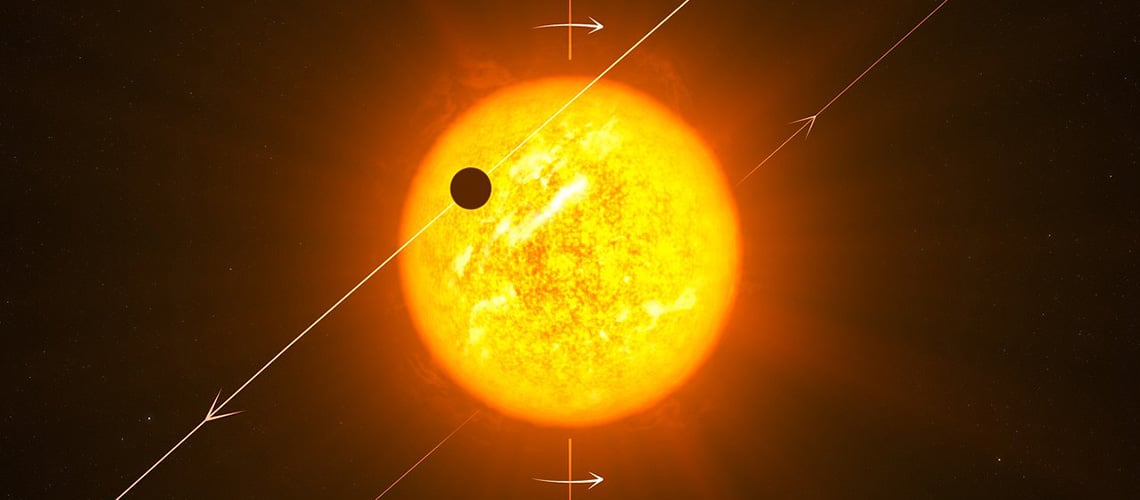
In our own backyard, the solar system is a masterpiece of cosmic order. The eight planets trace their paths in a neat, flat disc, dancing in perfect synchronization with the Sun's rotation. Even the moons and asteroids largely adhere to this planar norm, rarely deviating more than a few degrees from the ecliptic. For decades, astronomers assumed this harmony was a universal law of nature, a default setting written into the fabric of star formation. It seemed logical that every young star, spinning with its surrounding disk of gas and dust, would spin up its planets in the same direction, creating a synchronized cosmic waltz.
That assumption was challenged by the discovery of "hot Jupiters," gas giants found orbiting close to their stars in retrograde motions, but those were rare anomalies. Now, for the first time, researchers have identified a sub-Neptune exoplanet that is not just misbehaving, but actively rebelling. Leading a team from the University of Geneva, PhD student Yann Carteret and his colleagues have published a paper in Astronomy & Astrophysics detailing an object orbiting a red dwarf star in the opposite direction of the star's spin. This is not a minor tilt; it is a complete reversal, a planetary dance that moves counter to the very star it orbits.
The implications of this finding reach deep into the theories of how planetary systems form. Standard models suggest that planets coalesce from a protoplanetary disk that shares the star's angular momentum, resulting in prograde orbits. To find a planet on a retrograde path implies a violent history. It suggests that something catastrophic occurred after the planet formed, perhaps a gravitational interaction with another massive body or a chaotic migration through the dense debris of a young system. This discovery forces us to rewrite the rulebook, acknowledging that the architecture of other worlds can be far more chaotic and unpredictable than our own orderly garden.
The host star, a typical red dwarf, provides a fascinating context for this cosmic oddity. These stars are the most common in the galaxy, often enduring billions of years of stable existence. Yet, within this seemingly quiet environment, a planet has managed to carve out a path that defies the local gravitational norms. The fact that this system is so common yet so unique highlights the delicate balance required for planetary stability. A planet on such a steep orbit experiences extreme tidal forces and radiation variations, raising questions about whether life could ever take root there. The environment is likely a harsh one, a reminder that the cosmos is often stranger and more hostile than our stable home.
This discovery serves as a poignant reminder that the universe does not follow a single blueprint. Our solar system, with its predictable seasons and gentle orbital mechanics, might be the exception rather than the rule. As we continue to scan the skies with increasingly powerful telescopes, we are uncovering a galaxy of diversity where worlds spin backward, stand on end, and orbit in defiance of the status quo. It challenges us to humble our assumptions and accept that the universe is a place of infinite variety, where every story is written in the chaotic ink of gravity and time.
On Bluesky? Meet HomeSky.
Follower analytics, a growth toolkit, scheduling and AI posting — built for Bluesky. Connect your account and use everything free for 60 days.
Try HomeSky free →