BepiColombo Makes Up-Close Measurement of Mercury's Solar Bombardment
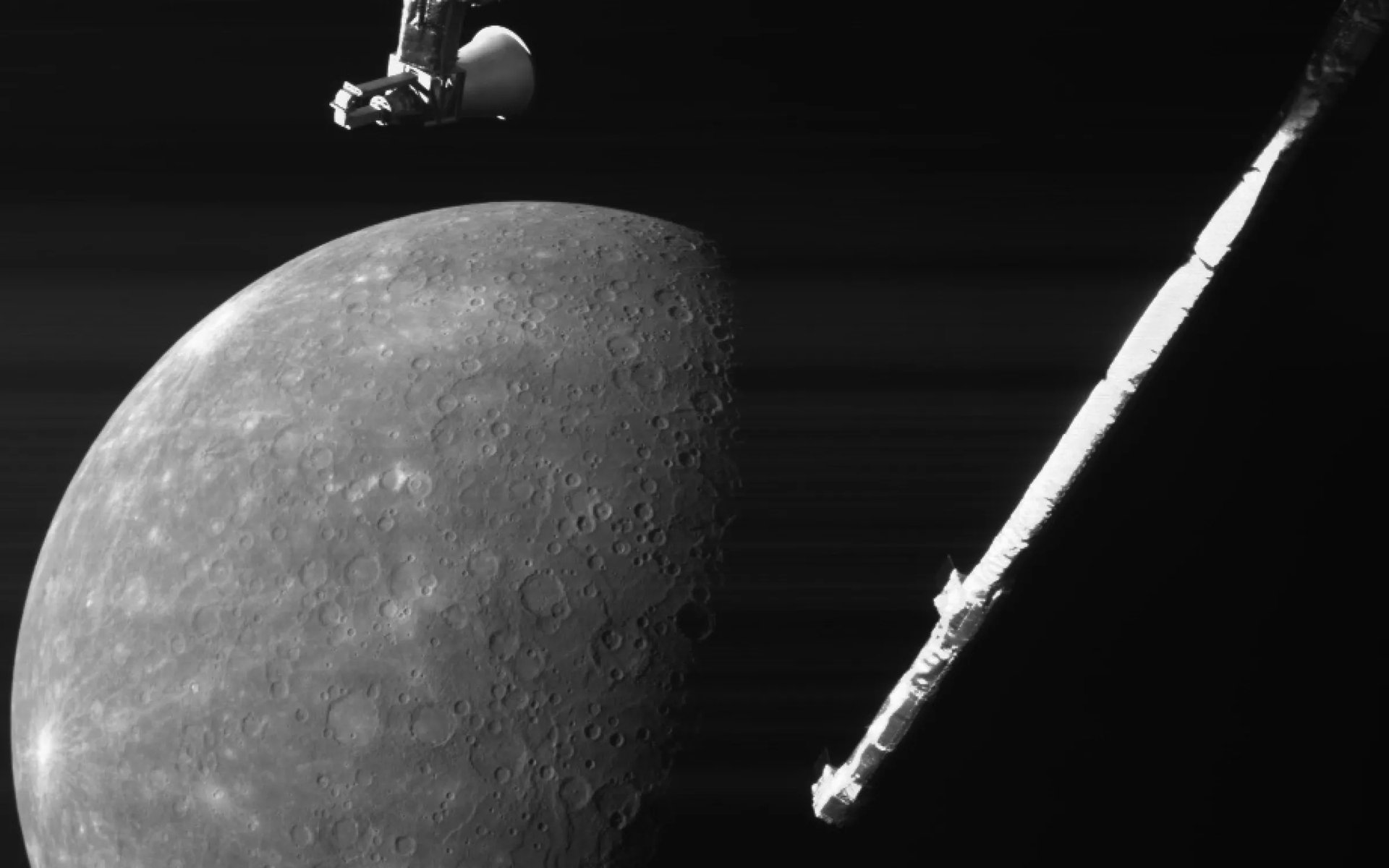
We often think of space as a quiet, empty void, a stage for distant stars and drifting asteroids, but the reality is that our solar system is a violent, dynamic place where invisible forces constantly reshape the landscapes we see. For Mercury, the innermost planet, this environment is particularly brutal. Bathed in the most intense solar radiation of any world in our system, its surface is subjected to an unrelenting barrage of charged particles that strip away its fragile atmosphere and alter its very chemistry. It is a harsh reminder that even a planet so close to our sun is not immune to the chaotic weather of the stellar core.
Enter the BepiColombo mission, a joint European endeavor that has spent years navigating the complex gravitational dance of the solar system to finally arrive at this fiery doorstep. This spacecraft is not merely a tourist taking pictures from a distance; it is an instrument of precision designed to measure the invisible. By hovering close to Mercury, it has begun to capture data on how the solar wind interacts with the planet's magnetic field and surface, providing the first high-resolution measurements of this particle bombardment. These readings are not just numbers on a screen; they are the key to understanding the physical processes that have sculpted Mercury for billions of years.
The implications of these measurements extend far beyond the scorched surface of the smallest planet. By studying how space storms affect Mercury, scientists can build a more accurate model of how similar events impact Earth's own protective magnetic shield and atmosphere. When a coronal mass ejection from our sun hits Mercury, the planet offers little resistance, allowing particles to rain down directly onto its crust. On Earth, our magnetic field deflects most of this energy, but knowing the exact mechanics of the interaction on a world with so little protection helps us understand the limits of our own defense. It allows us to predict how severe solar storms might disrupt our power grids or damage satellites, turning abstract space weather into tangible engineering concerns.
There is also a profound philosophical weight to this exploration, a sense of humility that comes from realizing how small and vulnerable our home world truly is. We tend to view Earth as a fortress, shielded by oceans, an atmosphere, and a magnetosphere, yet looking at Mercury reveals the raw, unfiltered face of the sun. It forces us to appreciate the delicate balance that keeps life on Earth stable. The data brought back by BepiColombo suggests that the solar system is a place of constant, energetic exchange, where energy flows from the sun, hits planetary shields, and scatters into the void, driving a cosmic cycle of erosion and renewal that has no equal on Earth.
As we continue to analyze these initial findings, the narrative of our solar system becomes clearer. It is not a static collection of rocks orbiting a star, but a living system of interacting forces where every planet plays a role in the grand exchange of energy. The work being done by BepiColombo is a testament to human curiosity and our drive to understand the mechanics of our own neighborhood. It reminds us that while we may feel secure under our sunlit skies, we are all part of a much larger, more energetic, and sometimes dangerous cosmic community.
On Bluesky? Meet HomeSky.
Follower analytics, a growth toolkit, scheduling and AI posting — built for Bluesky. Connect your account and use everything free for 60 days.
Try HomeSky free →