Migrating the GitHub Copilot runtime to Rust, using Copilot
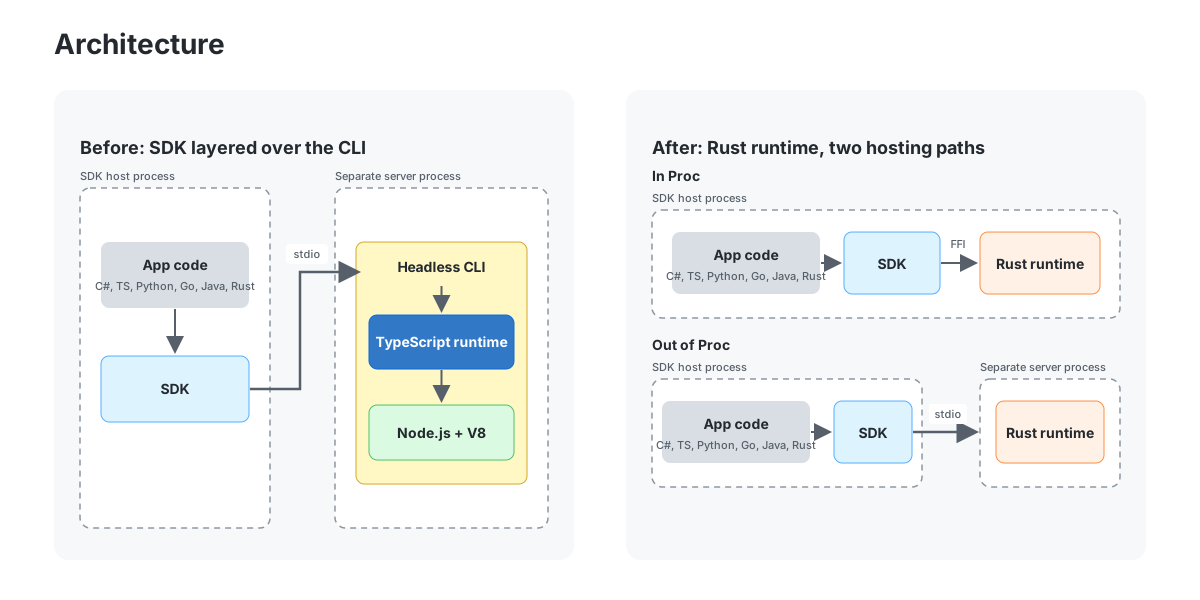
Before the era of autonomous agents, rewriting a system of this magnitude was a purely logistical nightmare, a mountain of debt that could only be climbed by armies of engineers working in lockstep. We stood at the precipice of porting the entire GitHub Copilot runtime, a beast comprised of nearly eight hundred thousand lines of code, from a legacy stack to Rust. In the days of old, this would have meant years of meticulous planning, risk aversion, and a slow, agonizing migration path where every change was weighed against the possibility of catastrophic failure. It was a task that felt impossible, not because of the technical difficulty, but because the cost in human hours was simply not affordable.
Then came the shift in paradigm, the arrival of agents capable of not just executing instructions but understanding context and navigating complexity with a human-like intuition. This capability turned a logistical impossibility into a manageable engineering challenge. Instead of manually refactoring thousands of files, we leveraged the very technology we were building to build itself. The Copilot agent was not merely a code completion tool; it became a junior architect, a senior reviewer, and a pair programmer all rolled into one, capable of grasping the monolithic scope of the runtime and tackling it piece by piece without losing sight of the forest for the trees.
The journey was not without its turbulence. There were moments where the agent proposed solutions that were syntactically perfect but architecturally unsound, requiring human intervention to course-correct. Yet, the velocity was unprecedented. By delegating the heavy lifting of boilerplate conversion, memory safety implementation, and concurrency models to the agent, our team was freed to focus on the high-stakes decisions: defining the new architecture, validating the logic, and ensuring that the resulting system remained robust under the immense load of real-time AI inference. It was a dance between human oversight and machine execution, a rhythm that accelerated our progress far beyond anything we could have achieved with traditional methods.
Porting to Rust offered a reward that extends far beyond the mere act of migration. The language's strict ownership system and garbage-free memory management forced a rigorous rethinking of our runtime's internals. What were once fragile pointers and manual memory allocations were transformed into a fortress of safety, eliminating entire classes of bugs that could have plagued a live AI service. The result was a system that didn't just run faster; it ran with a reliability that allows us to push the boundaries of what an AI-assisted coding environment can do, confident that the underlying infrastructure is as solid as the ideas it supports.
Looking back, the porting of the Copilot runtime stands as a testament to the changing nature of software development. It proves that the tools we use to build the next generation of intelligence can also be the scaffolding used to construct that intelligence itself. We did not just move code from one language to another; we evolved our workflow, leveraging agents to overcome the historical barriers that once defined large-scale system rewrites. The eight hundred thousand lines are now a foundation of safety and speed, built with the help of the very AI that sits atop it.
On Bluesky? Meet HomeSky.
Follower analytics, a growth toolkit, scheduling and AI posting — built for Bluesky. Connect your account and use everything free for 60 days.
Try HomeSky free →