Migrating the GitHub Copilot runtime to Rust, using Copilot
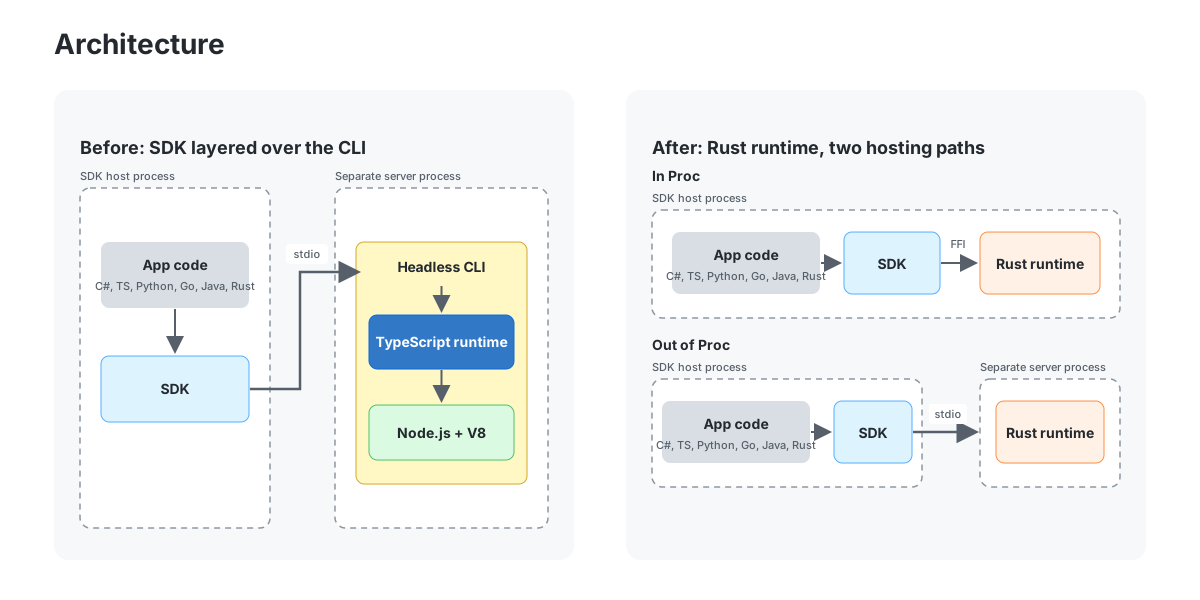
Porting a massive, production-grade codebase to a new language is often viewed as a monumental engineering feat, a Herculean task requiring months of manual refactoring and countless hours of debugging. For years, the sheer volume of legacy code acted as an immovable object, a barrier that made the idea of rewriting the GitHub Copilot runtime in Rust seem financially and temporally impossible. The cost of human labor was simply too high, and the risk of introducing regressions in a system serving millions of developers was deemed unacceptable.
However, the landscape of software development has shifted beneath our feet. The emergence of AI agents capable of understanding context, executing complex logic, and generating code with surprising accuracy has turned the tide. What once required a team of senior engineers working for months can now be approached with a dynamic strategy where the AI acts as both the architect and the primary coder. This shift doesn't just speed up the process; it fundamentally changes the economics of large-scale refactoring, making the previously unaffordable suddenly viable.
The journey of migrating the Copilot runtime to Rust involved tackling a beast of approximately 800,000 lines of production code. This wasn't a toy project; it was a critical infrastructure component that needed to remain stable while being completely rebuilt under the hood. The challenge lay not just in translating syntax from Python to Rust, but in preserving the intricate business logic, the subtle nuances of the agent's decision-making processes, and the robust error handling mechanisms that kept the service running smoothly in production.
Using Copilot to rewrite itself created a unique feedback loop where the AI could analyze its own previous output, identify potential inefficiencies in the Rust implementation, and iteratively refine the code. This self-referential capability allowed the team to achieve a level of code quality that would have been incredibly difficult to maintain manually. The Rust compiler's strict type system caught logical errors early, while the AI filled in the complex implementations, effectively bridging the gap between high-level intent and low-level execution.
The result was a system that is not only faster and more memory-efficient due to Rust's performance characteristics but also significantly easier to maintain in the long run. The migration validated a bold hypothesis: that advanced AI agents can handle the cognitive load of architectural transitions, freeing human engineers to focus on high-level design and strategic planning rather than the drudgery of line-by-line translation. It proved that with the right tools, even the most daunting technical debt can be cleared without breaking a sweat.
Ultimately, this rewrite represents a new era in software engineering where the boundary between human creativity and machine efficiency blurs. By leveraging the very tool we are trying to improve, we were able to build a better version of it, proving that the future of large-scale infrastructure maintenance is not about doing more work, but about working smarter with the assistance of intelligent agents. The 800,000 lines of Rust code standing today is a testament to what is possible when technology empowers us to overcome our own limitations.
On Bluesky? Meet HomeSky.
Follower analytics, a growth toolkit, scheduling and AI posting — built for Bluesky. Connect your account and use everything free for 60 days.
Try HomeSky free →