Migrating the GitHub Copilot runtime to Rust, using Copilot
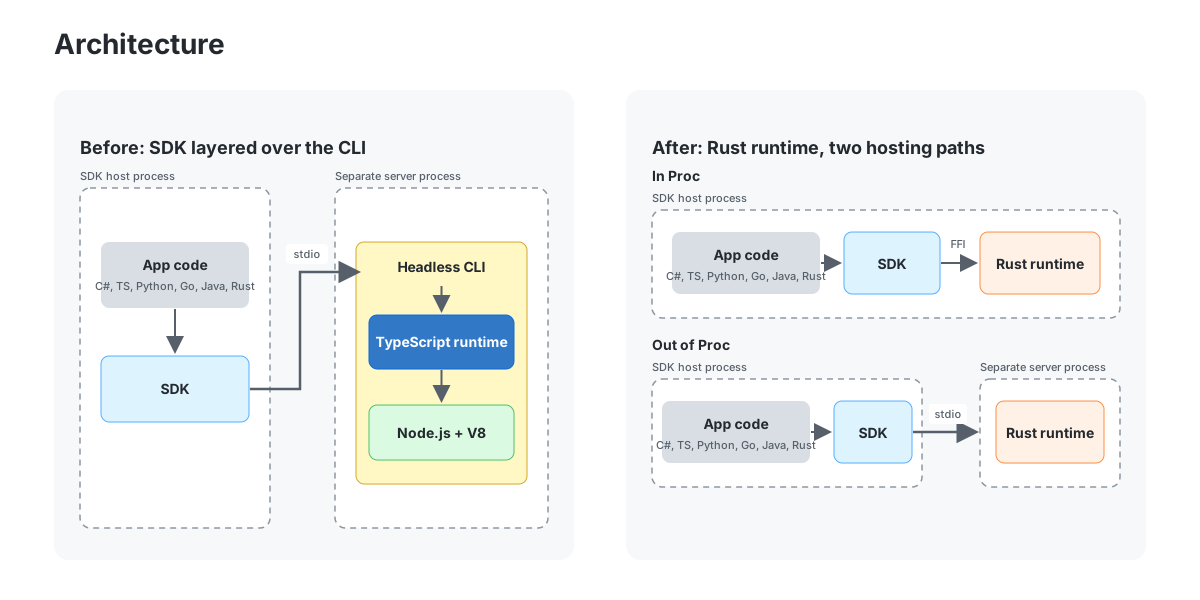
For a long time, the idea of rewriting a massive, production-grade service in a new language felt like a futile exercise in vanity. The GitHub Copilot agent runtime sits at over 800,000 lines of code, a sprawling ecosystem that had to be migrated to Rust. Before the advent of AI agents, this rewrite would have been a multi-year endeavor involving thousands of man-hours, risky manual refactoring, and a constant fear of breaking the very thing you were trying to improve. It was a cost-prohibitive gamble that most engineering teams simply wouldn't take.
But the landscape had shifted beneath our feet. By leveraging Copilot to write the Rust code that would eventually replace the existing stack, we turned an impossible timeline into a manageable sprint. The irony is palpable: we used an AI agent to rewrite an agent. This wasn't just about swapping syntax or optimizing memory allocations; it was about proving that modern software development tools could handle the cognitive load of massive system rewrites, freeing human engineers to focus on architecture rather than boilerplate.
The transition required a deep understanding of what Rust demands from you. Unlike higher-level languages that forgive sloppy memory management, Rust forces you to confront every resource allocation. The agent didn't just generate code; it had to understand the subtle interplay of lifetimes, ownership, and concurrency that keeps a real-time coding assistant stable under heavy load. We watched as the AI navigated complex dependency graphs, generating idiomatic Rust that integrated seamlessly with our existing infrastructure, effectively learning the "feel" of the codebase through sheer volume of interaction.
The result is a system that is not only faster and more secure but also fundamentally more reliable. The move to Rust eliminated a significant portion of potential runtime errors and reduced the attack surface for vulnerabilities. Yet, the true story here isn't just about the performance gains or the lines of code saved; it's about the paradigm shift in how we approach legacy modernization. We moved from a culture of cautious, incremental patches to one of bold, agent-assisted transformation.
This experiment challenges the traditional notion that large-scale rewrites require human-led, slow, and arduous processes. By offloading the repetitive and syntax-heavy lifting to an AI, we accelerated the pace of innovation without sacrificing the rigor required for enterprise-grade software. It demonstrates that the future of software engineering lies in the symbiotic relationship between human intent and machine execution, where AI acts not just as a pair programmer, but as a co-architect capable of undertaking the most daunting of migrations.
On Bluesky? Meet HomeSky.
Follower analytics, a growth toolkit, scheduling and AI posting — built for Bluesky. Connect your account and use everything free for 60 days.
Try HomeSky free →