Migrating the GitHub Copilot runtime to Rust, using Copilot
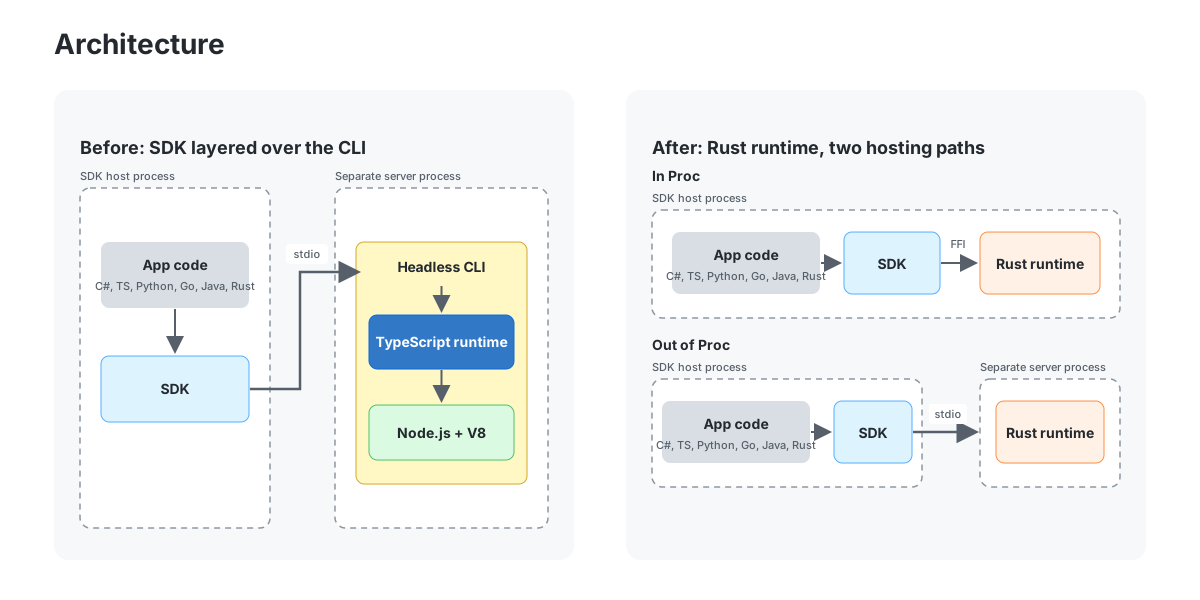
For years, the idea of rewriting the GitHub Copilot agent runtime in Rust felt like a theoretical exercise, a grand narrative of technological purity that was simply too expensive to attempt. The project spanned nearly 800,000 lines of code, a monolith built on a legacy stack that was stable but heavy. The cost of such a migration was not just financial; it was the prohibitive risk of breaking the very tool that millions of developers relied on for their daily workflow. Before the arrival of advanced AI agents, this rewrite was an impossible undertaking, a task that would have required an army of engineers and years of downtime that the product could never afford.
The turning point came when we realized that the agent itself could be the architect of its own migration. We didn't just ask Copilot to write a few utility functions; we deployed it as a full-stack partner to guide the porting process. This was a meta-experiment in engineering, using the future capabilities of our own AI to build the infrastructure that powers it. The result was a revelation: with the right prompts and a rigorous human-in-the-loop strategy, the AI could understand the complex, intertwined logic of the old runtime and translate it into idiomatic Rust with startling accuracy.
Porting this magnitude of code was not merely a syntax swap; it required a deep understanding of the underlying systems and the safety guarantees Rust enforces. The legacy code was a maze of dynamic behaviors that had to be reasoned through statically to ensure memory safety and concurrency without the heavy garbage collection overhead of the previous environment. Copilot acted as a persistent pair programmer, navigating the labyrinth of business logic, suggesting idiomatic patterns for ownership and borrowing, and flagging potential logical drift before it could compromise the system's integrity.
The challenges were significant, and they were not easily solved by automation alone. There were moments where the generated code hit a wall, requiring a senior engineer to step in and refine the approach, to explain the nuance of a specific edge case that the model missed. This collaboration created a feedback loop where the AI learned from our corrections, gradually improving its ability to handle increasingly complex domains of the codebase. It was a dance between human intuition and machine scale, proving that the best outcomes emerge from a synergy rather than a replacement.
The final output is a runtime that is leaner, faster, and more secure than its predecessor. By embracing the lessons of this massive migration, we have set a new standard for how large-scale infrastructure can be modernized without a single day of service disruption. The 800,000 lines of Rust now stand as a testament to what is possible when we leverage the very tools we are building to improve themselves, turning a theoretical impossibility into a concrete reality.
This journey also reshapes how we view the role of AI in software engineering. It is no longer just about generating snippets of code for small tasks; it is about orchestrating the evolution of entire systems. The success of this migration demonstrates that with the right approach, agents can handle the heavy lifting of architectural changes, freeing human engineers to focus on the high-level strategy and the creative problem-solving that machines cannot replicate.
On Bluesky? Meet HomeSky.
Follower analytics, a growth toolkit, scheduling and AI posting — built for Bluesky. Connect your account and use everything free for 60 days.
Try HomeSky free →