Migrating the GitHub Copilot runtime to Rust, using Copilot
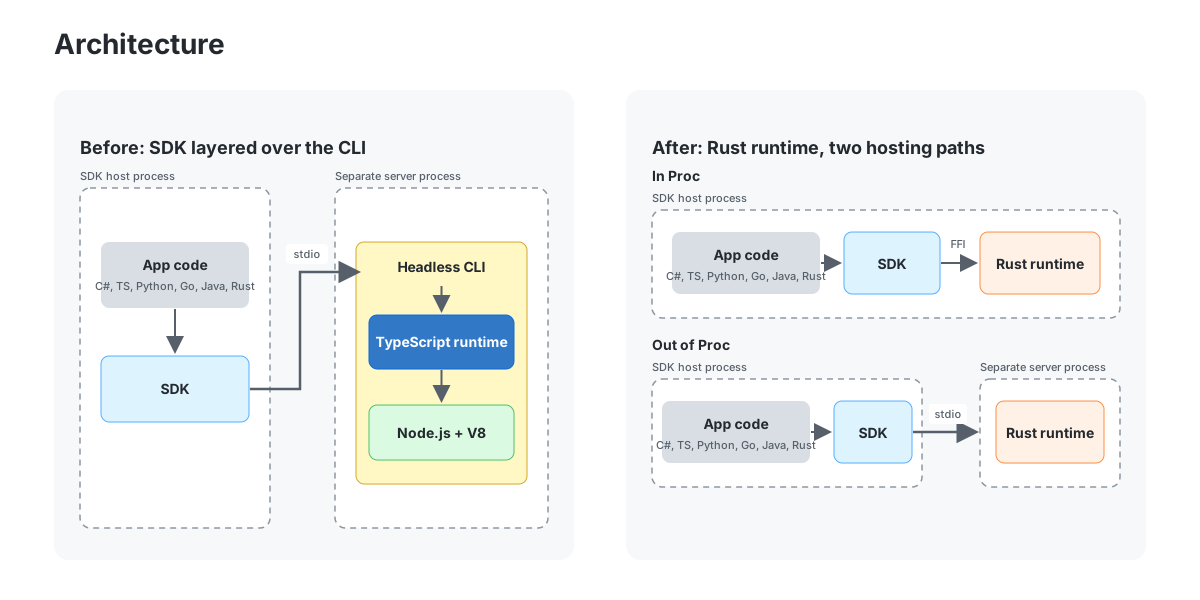
Before the dawn of autonomous coding agents, a rewrite of this magnitude was simply not financially viable. The GitHub Copilot runtime, a critical engine powering hundreds of millions of lines of code for developers worldwide, stood as a monument to the old guard of engineering. Porting such a complex system to Rust, a language renowned for its safety and performance but historically demanding a steep learning curve, required a level of precision and speed that traditional human-only teams could not guarantee without burning through entire budgets and timelines. It seemed like an insurmountable mountain, a project where the cost of failure outweighed the potential gain.
The turning point arrived not with a new compiler or a faster processor, but with a shift in how we approached the work itself. By leveraging Copilot, the very tool being migrated to Rust, the team transformed the rewriting process from a manual, labor-intensive grind into an accelerated, collaborative endeavor. Imagine having a pair of hands that never sleeps, capable of generating idiomatic Rust code, handling boilerplate, and navigating the intricate web of dependencies while the human architect focuses on the high-level design and architectural integrity. This symbiosis turned a theoretical impossibility into a practical reality.
The scope of the undertaking was staggering, encompassing approximately 800,000 lines of production-grade Rust code. In the traditional model, this volume of work would have spanned years, involving multiple teams, countless code reviews, and a high probability of introducing subtle bugs that could compromise the stability of the platform. With Copilot acting as a force multiplier, the velocity of development skyrocketed. The AI didn't just write code; it wrote safe, optimized, and context-aware code, allowing the engineering team to iterate rapidly, push boundaries, and solve problems that had previously been considered too risky to attempt.
This migration was more than a technological upgrade; it was a validation of a new paradigm in software development. It demonstrated that artificial intelligence could handle the gritty, unglamorous work of large-scale refactoring with a reliability that rivals human expertise. The resulting system is leaner, safer, and faster, running on the memory-efficient architecture that Rust provides, all while maintaining the seamless user experience that developers expect. The combination of Rust's strict type system and Copilot's contextual understanding created a feedback loop where safety was not just a feature, but a default state of the system.
Looking back, the decision to attempt this migration using the very agent being built represents a bold leap of faith. It was a gamble that paid off handsomely, proving that the future of software engineering lies in a partnership between human intent and machine execution. The journey from a legacy stack to a modern, Rust-native foundation was fraught with challenges, but the outcome was a more resilient, scalable, and efficient platform. It stands as a testament to what happens when we stop fighting against the tools of our trade and start harnessing their full potential.
On Bluesky? Meet HomeSky.
Follower analytics, a growth toolkit, scheduling and AI posting — built for Bluesky. Connect your account and use everything free for 60 days.
Try HomeSky free →