Migrating the GitHub Copilot runtime to Rust, using Copilot
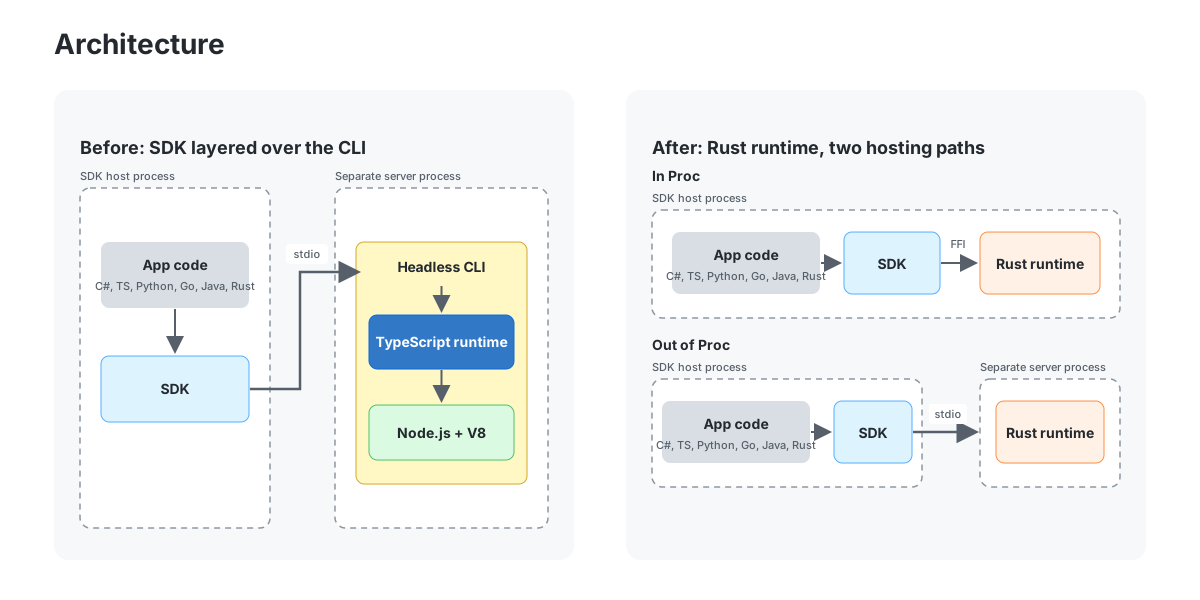
For years, the sheer scale of rewriting a complex system like the GitHub Copilot runtime was a prohibitive financial and engineering hurdle. Before the advent of sophisticated AI agents, such a migration would have required an army of senior engineers working for months, consuming resources that simply weren't justified by the risk of disruption. The idea of porting 800,000 lines of production code felt less like a standard upgrade and more like a high-stakes surgical procedure on a live patient, where the chance of introducing a regression could cost the company its footing.
The turning point came when we realized that the very tool we were building could be the one doing the heavy lifting. By leveraging Copilot agents to assist in the porting process, we flipped the traditional script. Instead of manually translating thousands of lines of code line-by-line, we allowed the agents to understand the context, generate the Rust equivalents, and handle the boilerplate that often slows down human developers. It was a meta-solution: using the product to build the foundation of the product itself.
The actual execution of this rewrite was not a smooth glide but a chaotic dance of verification and refinement. The agents could generate the initial Rust structure with impressive speed, but the real work began in the debugging trenches. We found ourselves in a loop where the agents would propose a solution, we would vet it against our internal security and performance standards, and then ask the agent to iterate based on our feedback. This created a feedback cycle that was far more efficient than writing from scratch, yet it demanded a new level of trust in the output that we had to carefully cultivate.
Porting to Rust introduced its own unique set of challenges that go beyond simple syntax translation. The language's ownership model and strict borrowing rules meant that a single conceptual bug in the original Python or other language could manifest as a cascade of compilation errors in Rust. The agents struggled initially with the intricacies of lifetimes and memory safety, often producing code that compiled but was logically flawed. This forced us to engage deeply with the generated code, turning every error into a learning opportunity that refined both our agent prompts and our understanding of the Rust ecosystem.
What surprised us most was how the agent runtime itself evolved during the migration. As the agents worked through the codebase, they began to develop a deeper understanding of our architecture, almost as if they were learning the system from the inside out. This led to optimizations that human engineers might have overlooked, such as more efficient data structures or cleaner separation of concerns. The result was a system that was not only faster to build but also cleaner and more maintainable than the version we were replacing.
Looking back, the migration of the Copilot runtime to Rust stands as a testament to the power of modern AI in software engineering. It proved that the barrier to entry for massive refactoring projects is not the size of the codebase, but the ability to delegate the repetitive and dangerous parts of the work to intelligent tools. We didn't just move code; we changed the way we build software, setting a new precedent for how future large-scale projects can be undertaken with the aid of autonomous agents.
On Bluesky? Meet HomeSky.
Follower analytics, a growth toolkit, scheduling and AI posting — built for Bluesky. Connect your account and use everything free for 60 days.
Try HomeSky free →