Migrating the GitHub Copilot runtime to Rust, using Copilot
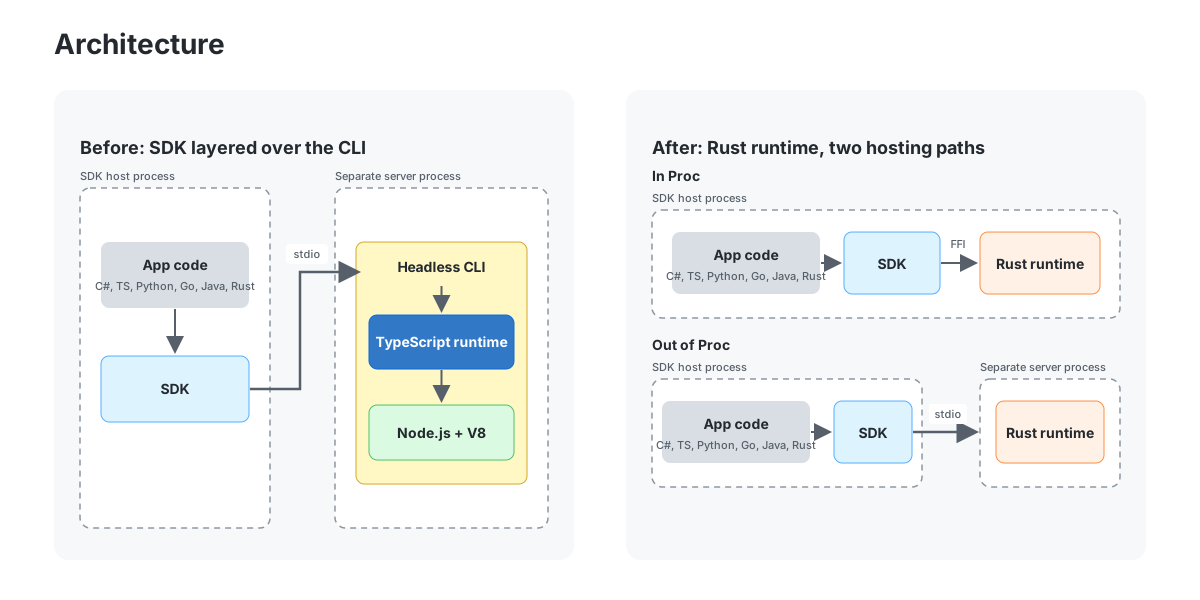
For years, the idea of rewriting a massive codebase using AI felt like a pipe dream, a sci-fi scenario reserved for movies where computers build themselves overnight. Before the emergence of intelligent agents, such a project would have been deemed financially impossible; the sheer volume of context, the nuance of legacy systems, and the risk of introducing subtle bugs made it an unaffordable gamble. Yet, here we are, having successfully migrated the GitHub Copilot runtime to Rust, a language known for its safety and performance, and we did it by leveraging Copilot itself to write the code that runs Copilot.
The scale of this undertaking was staggering. We were not tinkering with a small script or a single module; we were porting an entire production system consisting of approximately 800,000 lines of code. This wasn't a theoretical exercise in a sandbox environment; it was a live, critical piece of infrastructure serving millions of developers daily. The stakes were incredibly high. Every line generated by the AI had to be scrutinized, tested, and integrated into a system where reliability is non-negotiable. The goal was to replace an older runtime with Rust to gain memory safety and speed, but the method of execution turned the entire process into a meta-narrative of building a tool to build itself.
The challenge wasn't just about syntax translation; it was about architectural understanding. Traditional AI coding assistants often struggle with the holistic view of a massive legacy system, tending to focus on isolated functions rather than the broader flow of data and control. To overcome this, we utilized agents that could maintain context across thousands of lines, understanding dependencies and edge cases that a human reviewer might miss in a sea of code. It required a shift from asking the AI to write a function to asking it to understand a system, a level of abstraction that was previously unattainable at this scale.
As the migration progressed, the synergy between the human architects and the AI agents became a distinct workflow rhythm. Humans provided the high-level strategy, the security constraints, and the architectural guardrails, while the agents handled the brute-force task of translating idioms from one language to another. It was a dance of verification and generation, where the AI proposed solutions and humans validated them against the rigorous standards of Rust's ownership model. The result was a reduction in manual toil that allowed the engineering team to focus on optimization and feature enhancement rather than the painstaking line-by-line porting.
The outcome is a runtime that is not only faster and safer but also a testament to what modern software development can achieve when human intent is amplified by artificial intelligence. This rewrite, once considered too expensive to attempt, is now a standard operating reality. It proves that the future of large-scale system migration isn't about doing more with less, but rather about changing the ratio of human effort to machine execution entirely. We haven't just rewritten code; we have rewritten the rules of how we approach massive engineering challenges, turning a decades-old bottleneck into a streamlined, automated journey.
On Bluesky? Meet HomeSky.
Follower analytics, a growth toolkit, scheduling and AI posting — built for Bluesky. Connect your account and use everything free for 60 days.
Try HomeSky free →