APOD: 2026 September 18 – Messier 33: The Triangulum Galaxy
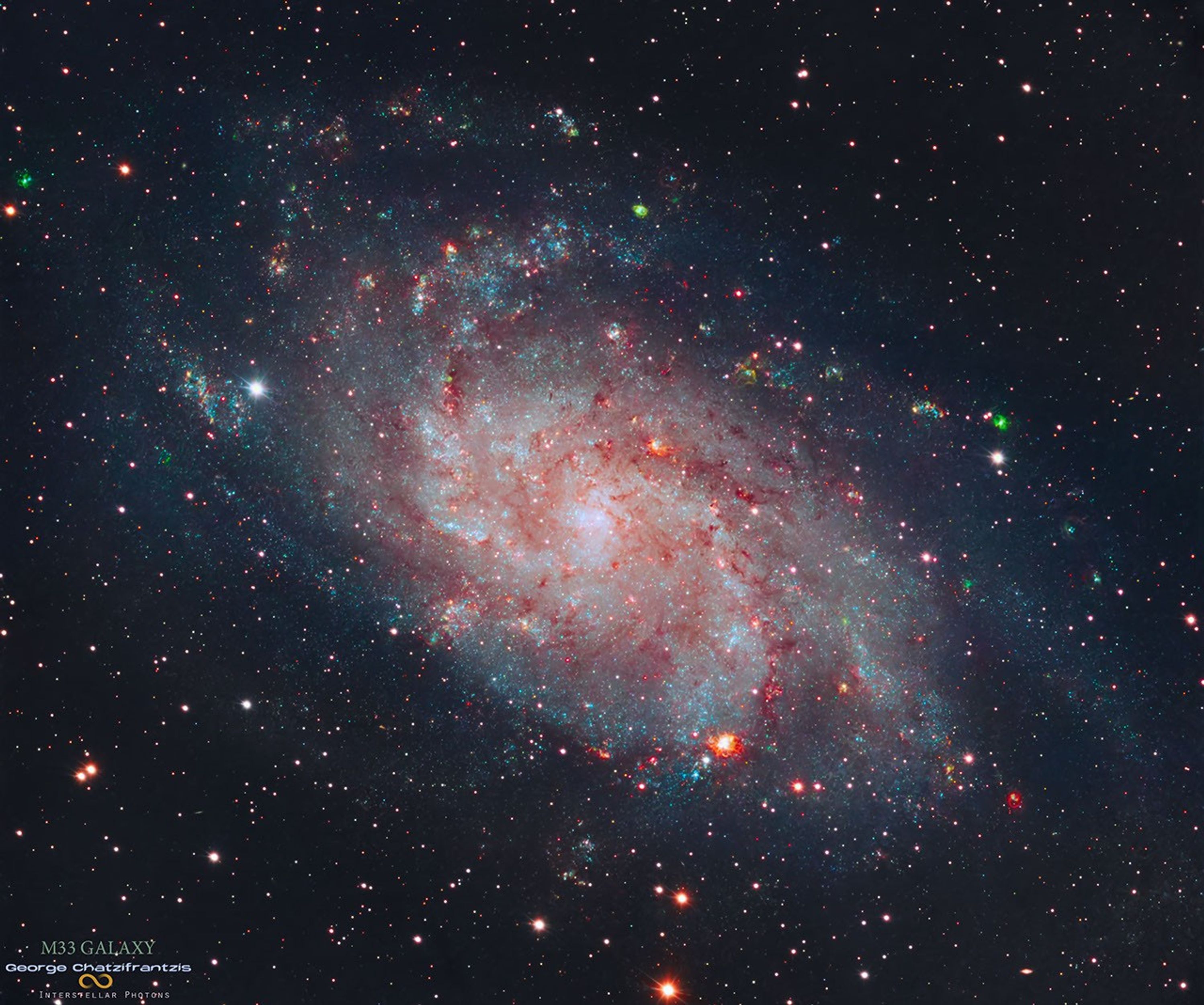
There is a certain humility required when we look up at the night sky, a realization that we are not the center of the story but rather a fleeting participant in a much grander design. On this specific date in the autumnal arc of our cosmic year, the heavens offer us a view of Messier 33, a spiral galaxy that has quietly held a place in our collective consciousness for centuries without demanding the chaotic drama of its more famous neighbors. It is a gentle giant, a vast island of stars and dust that drifts in the quiet company of the Milky Way and the Andromeda Galaxy, forming a loose trio known as the Local Group.
What makes Messier 33 so profound is not just its physical scale, which spans some fifteen thousand light-years, but the intricate architecture of its formation. Unlike the violent, face-on presentation of the Milky Way that we see from our own vantage point, M33 presents itself at a slight angle, revealing the delicate tendrils of gas and dust that are the cradles of new stellar life. These glowing nebulae, scattered throughout its disk, are the active birthplaces of stars, where gravity pulls together clouds of hydrogen and helium to ignite the fiery fusion that will eventually become suns. It is a reminder that the universe is not a static collection of rocks but a dynamic, churning engine of creation.
The history of this object is written in ink and paper, a testament to the human desire to map the unknown. Discovered by Charles Messier in the late eighteenth century, it was initially cataloged as a potential comet, an error that has since become a cornerstone of modern astronomy. Messier, a comet hunter at heart, sought to catalog fuzzy patches in the sky that might be mistaken for comets, ensuring that astronomers like Edmond Halley could focus on their true pursuit. This humble beginning, born from a practical necessity to avoid confusion, has evolved into a gateway for understanding the deep structure of our galaxy cluster.
Looking deeper into the data, we find that Messier 33 is currently engaged in a slow, graceful dance with the Andromeda Galaxy, a process that will culminate in a massive collision billions of years from now. While the Milky Way and Andromeda are locked in a tighter gravitational embrace, M33 orbits the center of this group with a distinct rhythm, occasionally passing through the outskirts of the Milky Way's halo. This interaction has likely triggered bursts of star formation in both galaxies, a phenomenon known as cosmic cannibalism, where the gravitational tides of a massive neighbor strip away gas clouds and ignite them into new generations of stars.
The beauty of M33 lies in its accessibility to both the amateur astronomer with a modest telescope and the professional gaze of space-based instruments. From Earth, it appears as a soft, hazy patch of light, a ghostly spiral that requires patience and a dark sky to fully appreciate. Yet, when viewed through the lens of modern observatories, the galaxy reveals a complex tapestry of ionized gas, dark lanes obscuring its core, and clusters of ancient red giants alongside youthful blue supergiants. It is a snapshot of time itself, a frozen moment in the ongoing evolution of structure and order in the cosmos.
As we gaze upon this distant pinprick of light, we are reminded of our smallness in the vast theater of space. Messier 33 does not care for our fears or our triumphs; it simply exists, governed by the laws of physics that bind us all together. In its swirling arms, we see the same forces that shaped our own solar system, the same chemical elements forged in the hearts of dying stars that now compose the air we breathe. It is a mirror reflecting our own origins, a celestial neighbor that invites us to look inward while we gaze outward, finding a shared humanity in the infinite silence.
On Bluesky? Meet HomeSky.
Follower analytics, a growth toolkit, scheduling and AI posting — built for Bluesky. Connect your account and use everything free for 60 days.
Try HomeSky free →