Migrating the GitHub Copilot runtime to Rust, using Copilot
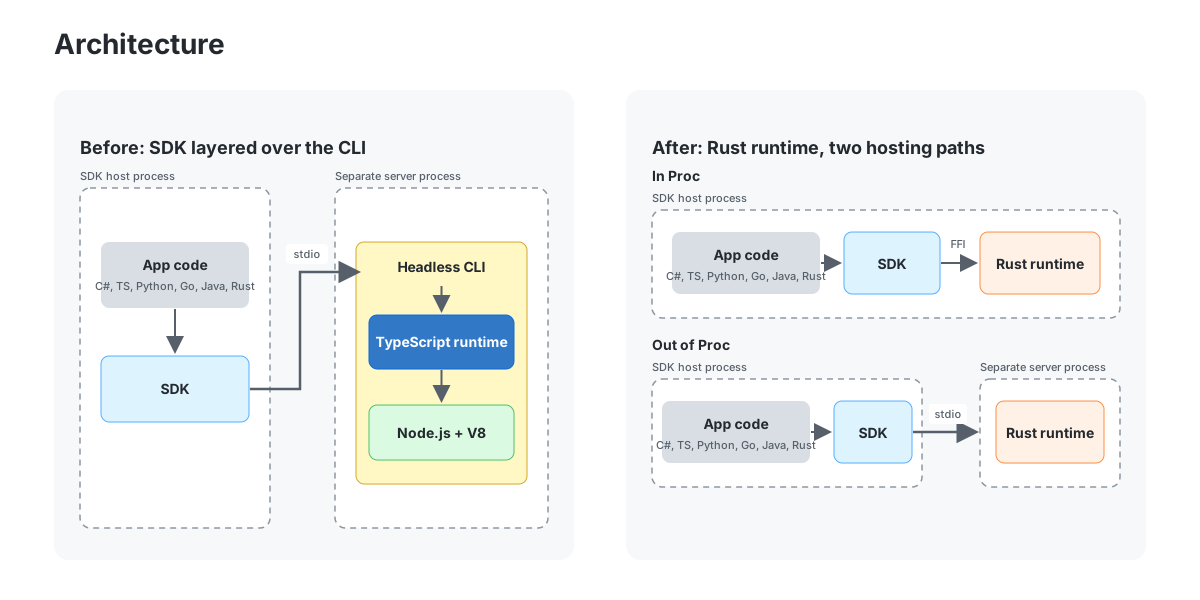
It used to be that rewriting a massive, critical codebase was a high-stakes gamble where the cost of failure was measured in months of lost productivity and the fear of breaking production systems. Before the rise of autonomous agents, porting the GitHub Copilot runtime to Rust felt like an impossible task. The sheer scale of the project, spanning roughly 800,000 lines of production code, created a barrier that traditional refactoring techniques simply could not climb without a dedicated army of engineers and years of incremental migration. The idea of tackling such a monolithic rewrite in one go was not just ambitious; it was practically absurd, a venture that would have likely resulted in a catastrophic outage before a single line of Rust was committed.
The pivot point came when we decided to leverage the very tool we were building to build itself. By using Copilot agents to orchestrate the migration, we turned a theoretical impossibility into a tangible reality, but the process was far from a magic button press. It required a sophisticated feedback loop where human oversight remained the captain of the ship, while the AI acted as the tireless engineer capable of maintaining context across hundreds of files simultaneously. This wasn't about letting the AI run wild; it was about establishing a rigorous verification pipeline where the agents proposed changes, humans reviewed the logic, and then the code was executed in a sandboxed environment to ensure safety before merging.
Porting to Rust introduced a new set of challenges that went beyond mere syntax translation. The language's strict ownership model and memory safety guarantees demanded a deep architectural rethink of how the runtime managed state and interacted with external services. The Rust compiler became an active partner in the process, catching subtle bugs that would have slipped through the cracks in the previous implementation. Every function signature had to be reconsidered, and data structures had to be reimagined to fit the borrow checker's rules, turning what might have been a days-long review process into a continuous, automated negotiation between the code and the compiler.
The results speak for themselves, validating the hypothesis that agents could handle complexity previously reserved for human-only endeavors. The migrated runtime is not just faster or safer; it is fundamentally more robust, with memory safety built into the language type system rather than added as an afterthought. We have eliminated entire classes of vulnerabilities that were inherent in the original implementation, proving that the overhead of learning a new language was vastly outweighed by the long-term gains in reliability. This shift has also accelerated our development velocity, as the type system of Rust acts as a powerful documentation tool that catches errors before they ever reach the testing phase.
This journey serves as a stark reminder of how rapidly the landscape of software development is shifting. What once required a decade-long commitment can now be undertaken in a fraction of the time when the right tools are applied with intention. The migration of the Copilot runtime to Rust is not merely a technical achievement; it is a testament to the evolving relationship between humans and machines in the creation of software. It demonstrates that the future of large-scale engineering lies in collaboration, where agents handle the grunt work of translation and verification, allowing engineers to focus on the high-level architecture and the creative problems that truly define the product.
On Bluesky? Meet HomeSky.
Follower analytics, a growth toolkit, scheduling and AI posting — built for Bluesky. Connect your account and use everything free for 60 days.
Try HomeSky free →