Migrating the GitHub Copilot runtime to Rust, using Copilot
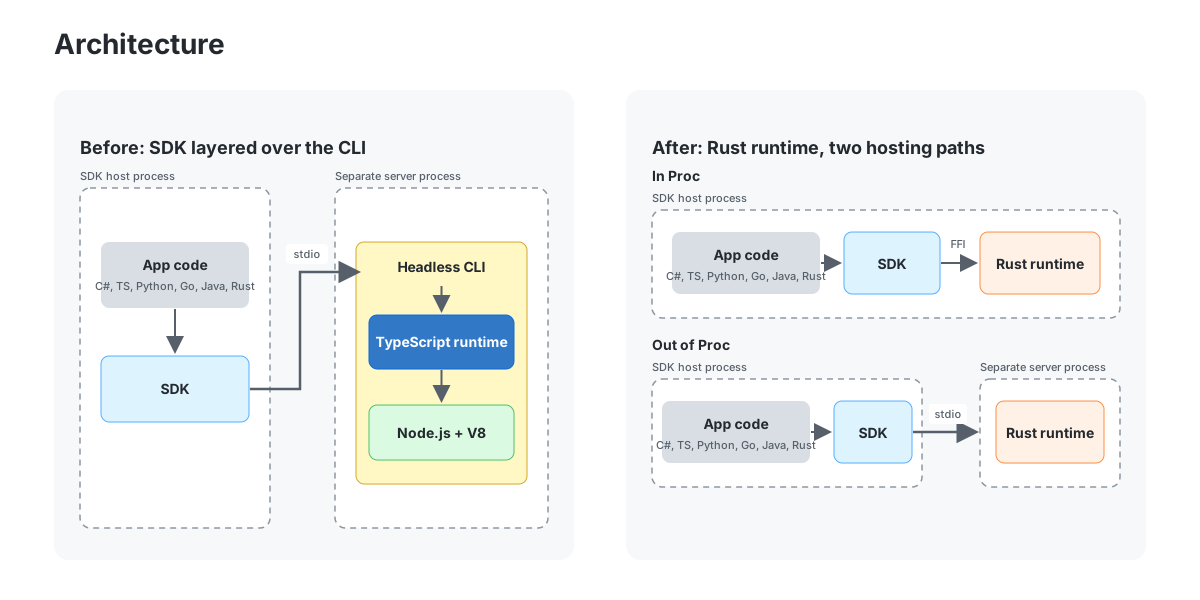
For years, the sheer scale of the Copilot agent runtime felt like an insurmountable wall of complexity, one that demanded a technology stack capable of handling hundreds of thousands of lines of logic without breaking a sweat. Before the advent of modern AI agents, undertaking a rewrite of this magnitude wasn't just expensive; it was arguably unaffordable in terms of both time and engineering resources. The decision to migrate the entire runtime to Rust wasn't merely a quest for performance; it was a strategic gamble on reliability, security, and the long-term maintainability of a product that serves millions of developers.
The journey involved porting approximately 800,000 lines of production code, a feat that initially seemed to contradict the very tool we were building. How could we rely on an AI assistant to refactor the very systems that power it? The paradox was fascinating: we were using the latest iterations of Copilot to write, debug, and optimize the Rust codebase that would eventually run the Copilot service itself. This recursive approach required a level of trust in the agent's capabilities that previous iterations of the product never demanded, pushing the boundaries of what an LLM could achieve in a real-world, high-stakes environment.
The technical challenges were not limited to syntax translation; they were deep dives into memory safety, concurrency models, and the rigorous type system that defines Rust. Every migration step involved a delicate dance between letting the AI generate plausible solutions and having human experts verify that those solutions met the exacting standards of a production-grade service. It wasn't about blindly accepting generated code; it was about leveraging the agent as a force multiplier for senior engineers, allowing them to focus on architectural decisions and complex logic while the AI handled the grueling task of boilerplate and low-level implementation details.
The outcome was a runtime that is significantly faster, more memory-efficient, and arguably more secure than its predecessors, but the true victory lies in the velocity it brought to the engineering team. By automating the heavy lifting of the port, the team could iterate on features and fix bugs at a pace that would have been impossible with traditional manual refactoring. This shift has fundamentally altered how the team approaches large-scale system modernization, proving that AI agents are not just assistants for writing new code, but essential partners in the evolution of critical infrastructure.
Looking back, the migration stands as a testament to the rapid acceleration of software development capabilities. What once required years of incremental work and massive budgets could be achieved in a fraction of the time, provided the team had the right tools and the willingness to embrace a new way of working. The success of this project validates the hypothesis that the future of software engineering isn't about replacing humans with machines, but rather about empowering humans with intelligent partners that can handle the scale and complexity that no single individual could ever manage alone.
On Bluesky? Meet HomeSky.
Follower analytics, a growth toolkit, scheduling and AI posting — built for Bluesky. Connect your account and use everything free for 60 days.
Try HomeSky free →