Migrating the GitHub Copilot runtime to Rust, using Copilot
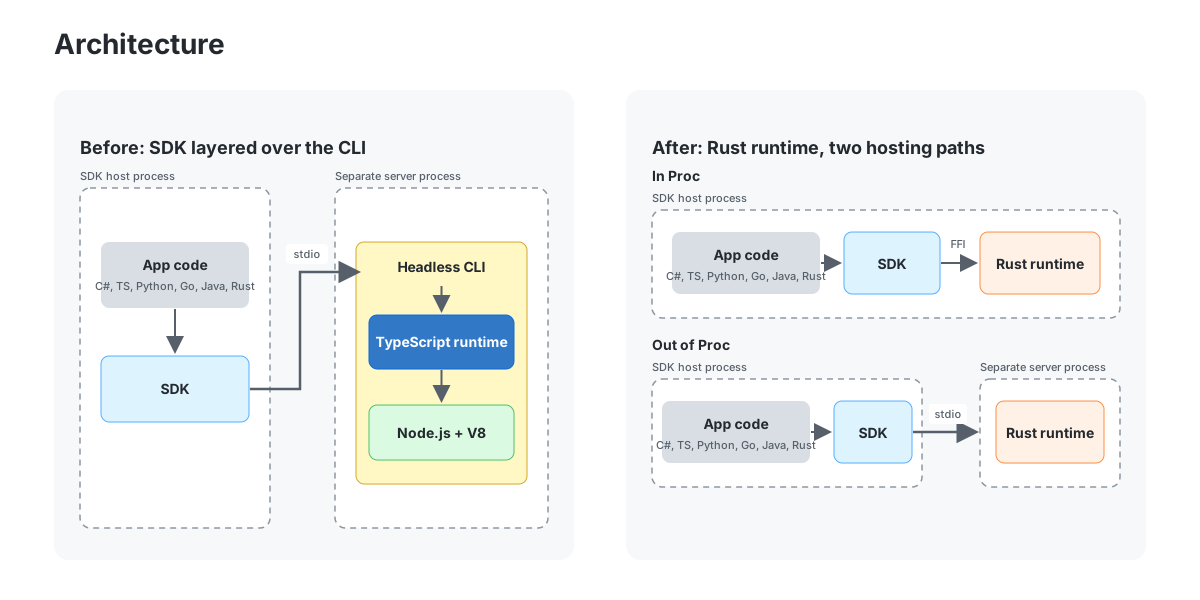
There was a time when rewriting a critical piece of infrastructure meant months of manual labor, endless context switching, and the constant fear of introducing regressions. The GitHub Copilot runtime, a system built to understand and generate code, was no exception. It was a monolithic beast written in Go, running hundreds of millions of lines of code, and moving it to Rust felt like an impossible task. The sheer scale of the undertaking, estimated at around 800,000 lines of production Rust, suggested that a human team would need years to complete the migration without losing their minds. Before the advent of modern AI agents, this rewrite simply wasn't affordable; the opportunity cost of losing the old system during the transition outweighed the benefits of gaining a faster, safer new one.
The shift in paradigm arrived not with a new hardware chip, but with a new kind of software collaborator: Copilot itself. By leveraging the very agent we were trying to build, we turned the migration into a self-referential loop where the tool became the architect of its own evolution. Instead of manually refactoring thousands of files one by one, we deployed a Copilot instance to the existing Go runtime. This allowed the agent to read the current state of the codebase, understand the business logic, and generate the corresponding Rust implementations in real-time. It was a moment of true recursion, where an autonomous system analyzed its own DNA and began rewriting itself to speak a more robust language.
What emerged from this process was a testament to the power of agent-driven development. The transition wasn't just a mechanical translation of syntax; it was a deep restructuring of how the runtime interacts with the underlying model. Rust offered strict memory safety and parallelism that Go could only dream of, but getting there required more than just swapping types. The agent had to reason about concurrency models, error handling strategies, and the specific nuances of the GitHub ecosystem. The result was a system that didn't just run faster but felt fundamentally more resilient, capable of handling the chaotic flow of developer requests without the risk of memory leaks or race conditions that plague interpreted languages.
Looking back, the journey highlights a broader truth about software engineering in the age of AI. The barrier to entry for massive infrastructure changes has lowered dramatically, but the skill set required has shifted. We are no longer just measuring engineering success by the number of lines written; we are measuring it by the complexity that an agent can safely navigate and refactor. The 800,000 lines of Rust didn't appear out of thin air; they were the product of a feedback loop where human intent guided the agent, and the agent's output refined the human's understanding of the problem.
This migration also underscores the practical reality of modern development cycles. In a traditional setup, the cost of experimentation is high; a wrong turn in the codebase can stall a project for weeks. With an agent capable of generating, testing, and verifying its own code, the cost of exploration drops to near zero. Teams can now attempt bold architectural overhauls that were previously too risky, knowing that an intelligent partner can validate the logic and catch the edge cases before a single human touches the production environment. It transforms the development process from a series of cautious steps into a sprint of continuous improvement.
Ultimately, the story of the Copilot runtime isn't just about Rust replacing Go; it's about the evolution of how we build the tools that build software. We started with a limitation—a system too big to move safely—and ended with a system that could move itself. As we continue to push the boundaries of what is possible, the fusion of human creativity and machine execution will only deepen. The next great rewrite might not be written by us at all; it might be written by the very systems we are building today, ensuring that our software evolves as fast as our ideas do.
On Bluesky? Meet HomeSky.
Follower analytics, a growth toolkit, scheduling and AI posting — built for Bluesky. Connect your account and use everything free for 60 days.
Try HomeSky free →